Contact ME

Use the form on the right to contact me.


123 Street Avenue, City Town, 99999

(123) 555-6789

email@address.com


You can set your address, phone number, email and site description in the settings tab.
Link to read me page with more information.

IMG_1267.jpg

Book of Days

BOOK OF DAYS: A POET AND NATURALIST TRIES TO FIND POETRY IN EVERY DAY

Sign up on the Contact Me page

November 25: Chickadees

Kristen Lindquist

The Maine state bird, the pert black-capped chickadee, is so common around here that we tend to take it for granted. It's a tiny bird with a simple song, and sports the same black and white plumage year-round. Of the birds that come to my feeder, the male cardinal, rose-breasted grosbeak, and goldfinch are much flashier, capturing more attention with their color and comparative scarcity.

But I think chickadees are my favorite visitor, because I can count on them. They're regulars. Every morning when I sit down at my desk, there's a flurry of chickadee activity at my little window feeder, and every afternoon when dusk starts to fall (these days, around 4:00) there's another flurry before they all head off to roost for the night. When I hear the soft, repeated taps of chickadees landing one after another on the feeder in late afternoon, I automatically look at the clock, knowing my work day is almost done. I like knowing that my feeder must be one of their last stops before nightfall. If the feeder is very low or empty, one will sometimes sit on the edge and yell, "Chick-a-dee-dee-dee," looking right at me--I swear it's telling me to get up and fill the feeder already.

Photo by Brian Willson

Each bird flits in quickly and pauses for a moment on the feeder's edge, bright eyes alert to any movements, including mine. It carefully picks through the seeds till it finds the perfect one (sometimes tossing aside the imperfect ones with seeming disdain), then flies off with it. The next chickadee, which has been queued up in a nearby bush, quickly follows suit. One chickadee--at least, I think it's one bird--likes to open its sunflower seed by banging it on the side of the feeder. You can hear it throughout the office, and I can't help but laugh each time at its clever talent.

The chickadee's tiny bird brain actually does something amazing this time of year--it grows extra brain cells so as to expand its memory to include all the places the bird is caching food for the winter. It's kind of like adding extra RAM to a computer. Even the smallest creatures are marvels of nature when studied closely.

Bright-eyed chickadee
looks in at me, grabs one seed--
the day is ending.
November 24: Vegetables

Kristen Lindquist

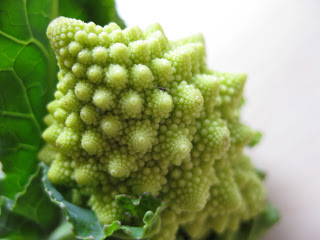
I had lunch today at Chase's Daily, an excellent vegetarian restaurant in Belfast that also doubles as a sort of farmer's market, with the back half of their space being filled with produce fresh off the farm. You wouldn't think there would be much to offer in late November. But I was surprised at what filled the bins and baskets back there: several types of squashes, beets, kale, architectural-looking Romanesco broccoli (see below--this stuff is cool!), cauliflower, parsnips, carrots, onions, rosy fingerling potatoes, celeriac, even paper white bulbs for forcing some winter blooms. A bounty of late season food, and certainly something for which to be thankful.

And did I mention they also have an amazing array of baked goods? Chocolate pear tarts, cherry coconut muffins, ginger cookies, breads... And cheeses. Mmmm. Is it obvious I'm writing this right before suppertime? Even now, the rest of the carrots I brought home are beckoning me from the kitchen...

Big, glowing carrot--
I eat it right from the bag.
Mouthful of autumn.


November 23: Midges

Kristen Lindquist

Tonight when we came home from a movie, our porch light was swarmed by midges. Such an odd thing to see in late November, this cluster of insects. The unseasonably warm weather must have brought on a late hatch. Now that the light is turned off, will they just freeze and die? 


Drawn to the porch light,
one last hatch of little flies
lasts one more cold night.


A short aside on my prosody here: Traditional Japanese poetry from which the haiku is derived made use of significant word play; words that carried more than one meaning added extra layers and depth to a poem. Such cunning punning created the pivots on which the poem turned, as with "last" in this haiku. Interesting to stop and think about how it ironically means both "final" and "enduring." The end rhyme was unintentional, and I thought about changing the last word from "night" to "hour," but then I decided that I don't really mind the rhyme this time around.

November 22: Driving Home

Kristen Lindquist

Spent my day driving home from Vermont. A long trip, punctuated by seeing nine roadside hawks and some blue sky. I was tired and wanted to get home in time for the Patriots game, hence I will confess that I was indeed speeding a wee bit at times. At one point, though, I shocked even myself at how fast I was going--definitely not my usual driving mode. (I feel compelled to add that I quickly slowed down and it didn't happen again.) Guess that's the lure of the open highway with home at the other end, good music, and little else in way of distraction...

Road, cars, tree a blur.
Must be anxious to get home--
going 95?!

November 21: Mountains

Kristen Lindquist

The classic Japanese woodblock artist Hiroshige created a series of prints called "One Hundred Views of Edo," in which Mount Fuji is a near-constant presence--sometimes prominent, sometimes in the distant background. There aren't many direct comparisons to be made between Burlington and Tokyo, I realize. But in fact, the mountains that surround this small city in Vermont are just as much a constant presence as Fuji is for Tokyo. Of course, Fuji is a bit more dramatic, being a very high conic volcano apparently rising from the plains. (I've never seen it in person.) But I still thrill to recognize the various mountains visible here--less singular than Fuji, but no less distinct in their effect on those who live near them and who see them on a regular basis.

From the crest of the hill in the middle of the University of Vermont campus, you look west across glowering Lake Champlain to be confronted by the jagged wall of the Adirondacks. To the north rises Vermont's highest peak, Mount Mansfield. To the south, the distinctively shaped bare peak of Camel's Hump juts up from among surrounding hills. When I was in college, I climbed both these mountains several times, and once snowshoed up Mount Marcy, the highest of the Adirondacks. Mountain tops are such meaningful places, places of power that summon their strength from the surrounding landscape below and constant contact with the clouds. They literally touch the heavens. To live in a city with the visual touchstone of a distinctive mountain (or two or more) allows you, in a sense, to tap into that power for yourself, as well as the beauty. I think of the excitement I've heard in the voices of friends in rainy Seattle when the weather's clear and "the mountain is out"--Mount Rainier is visible!

Mist rising from peaks,
mountains protect this city,
commune with the gods.

November 20: Crows

Kristen Lindquist

Yesterday I drove to Vermont, a state where I lived for five years (including four in college) and visit at least once a year to see my best friend and her husband in Montpelier. Vermont is a beautiful place, and if it only had an ocean, I might still be living there. (Lake Champlain, while once an inland sea, doesn't quite match up to Penobscot Bay.) So whenever I drive to Vermont and start seeing the familiar exits off I-89 and the profile of the Green Mountains rising to the west, I feel like I'm entering my second home.

Just at dusk as I was about to cross the bridge over the Connecticut River, which divides New Hampshire from Vermont, a massive flock of crows flew over, heading for their roost somewhere north of Lebanon. We don't often see such large numbers of crows--usually just one or two in the yard, or a small group mobbing a red-tailed hawk (which I also saw yesterday at Maine Audubon's Gilsland Farm). But even the family group I watch every day in my neighborhood belongs to some larger society of its kind. Also, unexpectedly large numbers of anything elicit awe (unless it's something like, say, fire ants or maggots, in which case that awe might be tinged with horror or disgust).

Dusk settles, crows flock,
a loose swarm headed for roost.
I too drive homeward.

Shortly thereafter, as it grew darker, I watched the young moon rise, and Jupiter hung clear and bright over the backbone of the Green Mountains.

November 19: Cranes

Kristen Lindquist

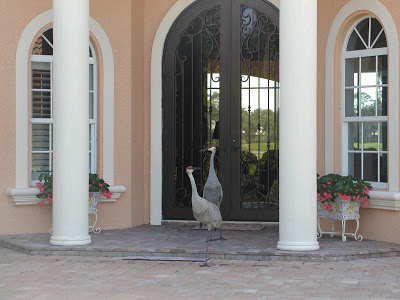
My friend Pat Palmer in Naples, Florida, has friends in Fort Meyers who regularly see sandhill cranes near their home. When she was there for a recent visit, however, she was disappointed to only see some birds flying over, nothing up close. Shortly thereafter her friends sent her this photo:


Pat replied that she didn't want to see another photo of the cranes till they were standing on the lanai.

Solemn grey, red capped,
waiting to be asked inside--
two crane visitors.

(Thank you, Pat, for today's inspiration!)

November 18: Cat

Kristen Lindquist

This morning when I pulled up the bedroom window blind, I was surprised to look out and see a small grey cat curled up in the middle of the lawn, seemingly quite at ease despite being settled atop a pile of frosted leaves. Its back was to me so it didn't notice me at the window. I wondered if maybe it was watching squirrels. It seemed alert, looking around without alarm, not huddled or fearful. When the furnace kicked on and warm vapors began to drift out from the furnace outlet vent just below the bedroom window, I wondered if maybe the cat was drawing on some small warmth by positioning itself there. Or maybe that was just coincidence. The incessant squirrel show that plays out in the backyard trees has been made all the easier to observe now thanks to the lack of leaf cover.

I was reminded of one of my favorite Hiroshige woodblock prints from the mid-19th century, Cat in Window, which depicts a bobtail white cat perched on a window sill, calmly looking out over the town at dusk, Mount Fuji and a flight of birds in the distant background. (It's part of the master artist's "One Hundred View of Edo" series.) The cat is the essence of watchful stillness. As a reminder to cultivate this quality in myself, a reproduction of this image once hung by my desk, when my own window looked out over bustling Rockland.


You look soft to touch
grey cat curled on frosted lawn,
calmly watching ... what?

November 17: Stars

Kristen Lindquist

Standing in the bone-chilling dark along the waterfront of Camden, Orion overhead, harbor below, the universe a pierced and sprawling void...

Orion's wide belt:
cosmic punctuation marks.
We're seeing the past!

Two for the price of one tonight:

Castor and Pollux,
twins, paired stars. Make up your mind
is what they're saying.

If I'd managed to glimpse a Leonid meteor, I might even have written three. I love seeing the classic stories of Greek mythology sprawled across the sky. Inspired by the constellations, you could retell a hundred tales and make up your own besides. The time of year when Orion rises is when I most enjoy sky-watching. His presence is for some reason such a comfort to me, as if he were a nocturnal giant watching over us while we sleep or some sort of star-made god.

November 16: Groceries

Kristen Lindquist

There's something kind of surreal about wandering the brightly lit aisles of a grocery store--past all those gaudy packages, entire rows of canned fruits, wine bottles with crazy labels, exotic fruits piled with apples and oranges, four kinds of Frosted Mini Wheats--while really tired. We had to do it, we needed food. But it wasn't easy. Still, poetry is everywhere, even when clouded by exhaustion.

Perfectly stacked cans,
bright boxes hold our dinner--
this is food for thought.

November 15: Fox

Kristen Lindquist


The inspiration for today's poem is my friend Brian Willson's Facebook status update this morning: "Up the foggy hill, about a dozen crows are hollering down at a fox that's exactly the color of fallen leaves." This evocative image got my creative wheels spinning in so many directions that I had to make use of it. Thank you, Brian.

What first sprang to mind when I read this was Winslow Homer's incredible painting "The Fox Hunt," which has haunted me ever since I first saw it at Boston's Museum of Fine Arts over a dozen years ago. Crows hound a fox bounding through deep snow, their black wings hovering above the struggling animal in a foreboding manner, sea brooding in the background. And as is typical with crows, more  are flying in to join the harangue. The beauty of this painting, aside from its aesthetic values of color, form, and movement, is its abbreviated narrative. We are given a snapshot of a poignant moment but never know if the fox successfully eludes these birds of doom.

Fortunately, Brian's fox--which he describes as "big, healthy, and fluffy-tailed"--is in less danger as it slips through the woods behind his house. Those crows are just marking its path, hoping to usher it out of their neighborhood. Though I have a feeling it will leave when it wants to leave.

We don't think of foxes as predators because they aren't big and ferocious like lions, tigers, and bears. Only when they're rabid do they scare us. A sort of combination of cat and dog, the fox lives near our houses without fear, inviting our familiarity while remaining wild, true to itself. (Though Russian scientists recently domesticated the silver fox in about 50 years of selective breeding.) In Western tradition, the fox's craftiness has long been celebrated in stories--from the wily fox of Aesop's fables to the sly trickster fox of British and American folklore. Fox-hunting has persisted as a tradition for so long in part because of the challenge presented by the quarry, which often outfoxes all those horses and hounds. In Japanese folklore, the fox is a trickster of more sinister aspect, a shape-shifting creature similar to a werewolf.

I could go on and on. Clearly, a rich tapestry of stories and traditions resonates around the fox, and even now most of us thrill to see a healthy one, its bushy tail waving and red fur glowing as it watches us with bright eyes and then disappears into the woods. With all its cultural baggage, a fox is more than just a fox--it's the embodiment of craftiness, survival, adaptation, and natural beauty. And a fox in the fog, camouflaged by leaves--is it just a fox or some kind of visiting spirit?

Marked by yelling crows,
fox the color of dead leaves
slips through autumn mist.