Contact ME

Use the form on the right to contact me.


123 Street Avenue, City Town, 99999

(123) 555-6789

email@address.com


You can set your address, phone number, email and site description in the settings tab.
Link to read me page with more information.

IMG_1267.jpg

Book of Days

BOOK OF DAYS: A POET AND NATURALIST TRIES TO FIND POETRY IN EVERY DAY

Sign up on the Contact Me page

March 15: Pussy Willows

Kristen Lindquist

Out a window at the back of the office, along a sunny wooded edge: pussy willows! One big bush was busting out all over with fluffy white catkins neatly aligned along the naked branches. Every since I learned the "Pussy Willow Song" as a kid, I've always been excited to see the first pussy willows of spring: "I know a little pussy. Her coat is silver gray. She lives down in the meadow, not very far away..."
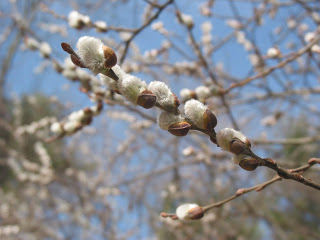
Photo courtesy of Wikipedia Commons
Besides their cuteness factor, pussy willows are also interesting from cultural and biological perspectives:

  • According to Wikipedia, some Christians in northern climates who don't have access to palm leaves apparently carry boughs of pussy willows instead. Makes practical as well as symbolic sense to me.
  • The pussy willow flower, which the catkin eventually blooms into, is an important early source of pollen for native bees. And our native bees need all they help they can get.
  • Studies have shown that pussy willow flower nectar is very high in sugar content. Good to know if you're lost in the spring woods--just suck on a bunch of pussy willows.
  • Many species of willow contain salicin in their bark, which is the basis for salicylic acid, a natural analgesic commonly known to us as aspirin. Also probably good to know if you're lost in the woods.
All very interesting, but really, what I love is that pussy willows embody the essence of renewal in early spring, the bare branches suddenly bursting to life with catkins while the leaves are still tight buds. I can never resisting cutting a branch or two to bring inside. If left in a vase without water, they'll last a long time. And while I'm at it, I usually cut a few boughs of forsythia, as well, to force their sunny blossoms (water required) a few weeks ahead of schedule. In Maine we get impatient for spring, so we make it happen.

Pussy willow buds
in coats of silver gray--spring,
childhood songs return.


March 14: Moss

Kristen Lindquist

On this dreary day of cold rain, I've been wistfully looking out my back window. A pair of crows caws in duet with my neighbor's dog's barking. The river seems to be at a normal water level again after a few days of looking at lines of exposed rocks; the Town must have adjusted the dam upstream. The bare trees show no hint of ever bearing leaves. Rain softly, steadily drums its fingers on the roof. I'm reminded of the last line of a poem by e.e. cummings: "nobody, not even the rain, has such small hands." (Though he's out of vogue now, e.e. cummings' poetry includes some of the most romantic love poems.)

Anxious to find something to lift my spirits, I've been fixating on my shed roof. My eyes are drawn to the bright chartreuse color of the moss on the roof's north-facing side. It's a vibrant, almost electric green. Years ago on a hot summer night on a porch surrounded by lawn and lush fields, a group of friends and I shared a bottle of Chartreuse. Until that evening, I didn't know what Chartreuse was, and hadn't realized that the color name came from the actual color of this liqueur made by French monks out of a veritable garden of herbal extracts. (Their original monastery was in the Chartreuse mountains.) We decided that because it was made by monks, it must be a spiritual sort of drink that would fill us with the green energy of all the plants that made it. It tasted like fresh grass translated into alcohol, distilling into a drink the verdant beauty of the fields that surrounded us. We were imbibing the very place itself, and it felt like magic.

Now this freakish moss, the only green I can see out my window on this mid-March day, has brought me back to that moment. I can almost taste it.

Only green in sight:
chartreuse moss on my shed roof.
The world will revive.

March 13: Open Window

Kristen Lindquist

I readily admit I'm a wimp about the cold. So that might explain how momentous it was for me this afternoon, despite the lingering chill in the air, to open the window over my desk. My initial purpose was to see if I could figure out what was going on with the cawing, swirling gang of about eight crows out back. (They must have been playing some kind of indecipherable crow game, because no other bird or beast seemed to be involved.) Once I got the window open, however, and felt real live air pouring in, I realized that it had probably been months since I last opened a window. I could hear the crows, of course, as well as the neighbor's barking dog, the quiet white noise of the river, sociable mallards cruising up and down the banks in interchanging pairs, a scolding squirrel, and the rustle of crisp, wind-tossed leaves blanketing our yard. Now, even though I'm freezing, I'm hesitant to close the window and cut myself off again from what's going on out there. Although, every time a gust of winds stirs up all those dead leaves, it's reminding me that soon I'll have to undertake my annual chore of raking the yard to expose my flower beds and lawn to what will hopefully be the kinder, gentler air of spring.

An open window:
rustle of dead leaves, crisp breeze.
Not quite warm enough.

March 12: Birches

Kristen Lindquist

While I have a birch tree or two in my backyard, this entry was not inspired by any birch I've seen today. Today is my friend Shannon's birthday. (Happy birthday, Shan!) We've known each other since high school, and in thinking about her today, I was reminded of some of the antics we shared more than 25 years ago. We would cruise around listening to the Grateful Dead (American Beauty) or Bob Dylan (Freewheelin' Dylan) really loud. When a song came on that we particularly liked, say, "Box of Rain," she'd enthusiastically honk the horn a few times. And when the music wasn't blasting, we'd share those deep conversations you only have as a teenager, about music and art and places we wanted to visit in the world. Shannon was daring and creative in ways that I was not; she inspired me with her rebellious independence.

We were (and are) admirers of the artist Neil Welliver, a nationally known painter who lived in Lincolnville. Shannon's parents owned a beautiful print of his that I coveted depicting the night sky over Pitcher Pond. As the next best thing, I owned a big poster of his painting Birches, which I loved because it so perfectly captured the light and beauty of the local woods. That image followed me to college and, until a few years ago, hung on my office wall. Sometimes when Shannon and I were driving around, we would come across a scene of wintry birches like that on my poster, and she would honk the horn. For my "senior gift" before high school graduation, I was given a laminated copy of the Robert Frost poem "Birches." I'm sure Shannon was behind that. We reconnected as friends years after high school, and she still possesses that same spontaneous, contagious sense of unselfconscious joy. And she still inspires me.

Friends then and friends now.
Birches make me think of you,
recall youth's freedoms.

March 11: Church Bells

Kristen Lindquist

When I got out of my car in my driveway tonight, I heard bells ringing in the twilight. I have no idea where the musical chiming was coming from--perhaps the church up on Cobb Road, though it sounded closer. The sky overhead was the deep clear blue of a cathedral ceiling. It was a lovely, profound, mysterious moment--offering a perfect mental transition from work to the relaxations of home.

Church bells at twilight.
Soon the spring evenings will ring
with calls of wild geese.

March 10: End of Day

Kristen Lindquist

These late afternoons when the light lingers temper the end of my work day. Instead of anxiously rushing to finish up this task or that report, I find myself standing at the window looking out at the river reflecting these last bits of light. This is the time of day when those last golden rays of sunlight slant through the bare trees, and birds (and people) head home for the night. The vultures tilt and glide their way to their mountain roosts, ducks fly past in quick, small flocks, and chickadees make one last visit to the feeder (in fact, here's one now, as I type). Somehow leaving work with some remaining daylight doesn't seem so hard on one's state of mind as leaving in the pitch dark. There's still some time left to gather oneself, to do something, even if it's just looking out the window as dark settles, waiting for streetlights to come on and stars to brighten over the mountain.

Mallards fly upstream,
set down on reflected trees--
remains of the day.

March 9: First Vulture

Kristen Lindquist

That first day of work after a vacation always sinks one back into the mundane fairly quickly. After spending a few hours in my office, I drove to a meeting in Rockland. In addition to thinking ahead to my meeting, my head was crammed full of work-related thoughts, the slightly rusty wheels grinding away, trying to get back into the proper mindset to get my job done. I crossed Route 90 onto Meadow Road, and suddenly noticed a lone turkey vulture soaring above the fields. I had just seen kettles of hundreds of vultures in Florida, so it didn't register at first what I was really seeing: my first vulture of the season! I waved to it out the car window, welcoming it back and wishing it luck in finding good thermals to ride and some dead things to eat.

Later this afternoon, four vultures cruised over the office. They're back! And we're officially on track for spring. From now until sometime in November I will probably see vultures circling over the river below the Megunticook ridgeline almost every afternoon. All is right in this part of the world. Up next: blackbirds, woodcock, robins...

Ah! Soaring vulture
buoyed by the earth's warm breath--
first of the season.

March 8: Hint of Spring

Kristen Lindquist

As the sky shifted from blank to blue this morning, I decided to go for my first run in a couple of weeks. I bundled up in tights, long-sleeved tee, hooded sweatshirt, and hat, and headed out. Little did I realize that what looked like a chilly, bleak, early March day was really a warm, sunny almost-Spring day. I began to overheat and ended up running with my sweatshirt tied around my waist.

It occurred to me that the temperature might be similar to what it had been when we were in Florida, where it was unusually chilly. In actuality it was probably a little cooler here, but because we still expect it to be wintery, it felt warmer. Also, here I wasn't surrounded by gently waving palm fronds and other lush greenery, or egrets, painted buntings, roseate spoonbills, and ibises. A cardinal sang briefly amid still-bare branches of a maple, and I thrilled to hear a chattering chorus of goldfinches in a tree near my parents' house. A pair of geese floated in the open river, as well as a lone, lingering bufflehead. It won't be too long before I hear the red-winged blackbird's "conk-a-ree" call from the river's edge or see vultures soaring over Route 105. Tempering my optimism for the shifting season, however, was the view before me of the summit of Bald Mountain still very much covered with snow.

Geese are returning.
I run in just a t-shirt
past snowy mountains.

March 7: Sea Salt

Kristen Lindquist

A friend gave us today a small bottle of sea salt from the waters off Spruce Head. Throughout the winter he boils off seawater on his wood stove and collects the salt residue. Now we can season our food with genuine local salt. In this new era of eating local foods, I hadn't thought before about how even salt can be found so close to home. Living on the coast, we are surrounded by sea salt, but I never think about harvesting my own as I would wild berries or mussels.

This home-grown process of "making" salt reminded me of a poignant section of The Tale of Genji in which Prince Genji goes into exile for a while in a remote coastal village on Suma Bay, far from his many lovers and the excitement of the capital. While there, he exchanges letters and poems with a former lover, including this one, which in Japanese apparently contains double meanings hinting at a longed for but forbidden meeting.

At Suma Bay
on the beach is the sea grass
which one knows so well.
What do the women boiling salt
from seawater think of it?

(Translated by Jane Reichhold with Hatsue Kawamura)

Being a sophisticated city guy, Genji is charmed by the quaint scene of the peasant women boiling seawater for salt on the beaches. His lover's reply poem references, of course, briny tears on her sleeves over their separation. Sleeves dampened by tears / dew / water seemed to be a common image of pathos in Genji's time.

I, on the other hand, not having such emotions to draw upon now, boil down my thoughts into a poem that is more "salt of the earth:"

Bottle of sea salt--
this harbor's waters offer
something essential.

March 6: Bird #100

Kristen Lindquist

Birders in general are a list-oriented group. We keep life lists of all the species we've ever seen, state lists, yard lists, and trip lists. I even keep a list of how many species I've seen at the Land Trust office (92). Earlier this week when we were on Sanibel Island, we met Don and Lillian Stokes (of field guide fame) in Ding Darling NWR. After learning that we were there for a week, Don suggested that 100 species was a good goal for a Sanibel bird list. Of course, we were only on Sanibel for three days--if he'd known we were also going to spend time in Corkscrew Swamp Sanctuary and Everglades National Park, he might have suggested a higher goal. As it was, we decided 100 different bird species was a good goal for intermediate birders like ourselves. So throughout the week I kept close track and updated my husband each night with the tally to date.

We left for the Fort Myers airport this morning having seen 98 species. Fortunately for our pride as birders, we arrived at the airport having reached our goal. Bird 99 was mallard--a small flock seen in a pond while still in Naples. Bird 100, however, was an unexpected and exciting one: two sandhill cranes flew overhead as we drove I-75 to Fort Myers! So with some sadness we leave behind sunny Florida, our gracious friends who hosted us for the past four days, and all these wonderful birds, but we leave satisfied.

Westward flying cranes
don't know their significance
to these two birders.

March 5: Last Day

Kristen Lindquist

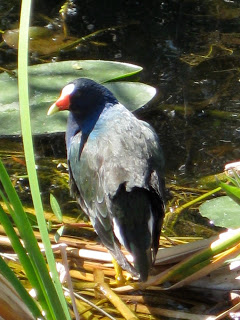
Today was the final day of our vacation before we fly back to Maine tomorrow, and we spent a good part of it at the Shark Valley section of Everglades National Park. The canal along the seven-mile walkway there teems with birds, alligators and other reptiles, and butterflies--it's hard to decide when and where to turn around, because there's that constant anticipation of what you might see or hear next. One of my favorite birds seen here is the strikingly colored purple gallinule, but other highlights of today included a nest of fuzzy baby anhingas, young green herons walking on lily pads, another swarm of migrating tree swallows, huge kettles of vultures, singing white-eyed vireos, bobbing prairie and palm warblers, a foraging limpkin, a young wood stork rooting around in the weeds, and some cool butterflies: zebra, white peacock, and Palmida swallowtail. Knowing it was our last Florida outing, I just wanted to go on and on... But, as I was told as a child by an elderly woman I was staying with in Scotland, "All things come to an end, and the black pudding comes to two."

Always another
egret, spoonbill, gallinule
around the corner.