Contact ME

Use the form on the right to contact me.


123 Street Avenue, City Town, 99999

(123) 555-6789

email@address.com


You can set your address, phone number, email and site description in the settings tab.
Link to read me page with more information.

IMG_1267.jpg

Book of Days

BOOK OF DAYS: A POET AND NATURALIST TRIES TO FIND POETRY IN EVERY DAY

Sign up on the Contact Me page

April 28: Raindrops

Kristen Lindquist

Last night as I was falling asleep, I thought I heard the cat purring loudly next to the bed. I asked my husband if he could hear her, and he said all he could hear was the rain. It wasn't till a little later, when the cat jumped up on the bed and began purring, that I realized that the noise I'd heard wasn't a contented feline but was, in fact, rain drumming the roof, lulling me with its low, soothing cadence.

I thought of this when, laid low by allergies, I was trying to nap this afternoon. Rain was coming down again, only this time it sounded like a military parade drum-roll as it rhythmically tapped the propane tanks outside the bedroom window. Several years ago I recall awakening on a summer night to the sound of cars driving on wet streets, thinking I was hearing waves crash on my grandparents' beach. Rain can be so many kinds of music. As Eric Clapton sang, "The sky is crying, look at the tears rolling down the street..."

While the clouds were pouring and purring a rainy lullaby on our roof, snow fell silently northwest of here. Friends in Vermont report waking up to snow this morning.

Rain pours down, it purrs,
curls its tail around our house,
lulls us back to sleep.

April 27: Waves

Kristen Lindquist

In a recent conversation with a friend about a surfing film festival he had attended, we both agreed that surfing movies were cool to watch because big waves are so fascinating. That's a simplification of the complex feelings many of us have for waves, which are truly energy made visible, manifestations of the action of wind upon the face of the waters. Growing up near the ocean, I have long loved watching waves.  My grandmother and I used to lie in bed and count to see if every seventh wave was the biggest. I would keep my bedroom window open in all seasons so that I could hear the crash of the waves upon the rocky shore, the rhythmic breath of the ocean. I paste a copy of Hokusai's 18th-century wood-block print "The Great Wave off Kanagawa"--an iconic image that has resonates deeply for me--on the cover of all my journals. Look at the loving detail with which he represents the wave's foam, the curling crest of the wave like a bunch of reaching claws or an opening mouth about to engulf the small boats below:

And therein lies my personal problem with waves. Fascination is the flip-side of fear. Ever since I was tumbled by a huge wave as a kid at Sand Beach in Acadia National Park, I have been afraid of waves. This fear has expressed itself all these years in my dreams. When I was a child, I would dream that the waves on my grandparents' beach were rising over the bank to carry away the house with me in it. In addition to that specific recurring dream, my subconscious shares with me on a regular basis many variations on the theme. In some dreams I'm swimming, and high-crested waves are carrying me away from shore or threatening to drown me. In others, I'm onshore and a wave sweeps over me. Last night I dreamt that I was watching some big rollers crash on a beach. The water was transformed into muscular blue fists--you could feel the power as they drew themselves up before pounding the shore. I was marveling from a distance at how amazing they were when suddenly a rogue wave lifted me up from behind. I had just enough time to think that I'd be lucky to survive its hurling me onto the beach and tumbling me around. Then I woke up. 

I guess it's a good thing I didn't go to the surfing movie fest, if just talking about waves gave me such a dream. Imagine what nightmarish images all those translucent curling wave shots, all those surfers tumbling into the foam, would have planted in my subconscious. 

Waves roll through my dreams,
curling around my childhood,
washing all away.

April 26: Shadbush

Kristen Lindquist

As I was driving away from my office today on an errand, I stopped the car in wonder at a beautiful flowering tree that I had somehow completely overlooked in front of the building. Granted, the tree is not outside my windows. And most of the flower-bearing branches are well above my line of sight. But still, you'd think I'd have noticed a 30-foot-high tree laden with sweet, white blossoms! The sun shining on it made all the white petals glow. The tree stood there like a revelation, an amazing artifact of spring. How could I have missed it all the years I've been working at the Land Trust? What's even worse is that I walked under that very tree earlier in the day without even noticing all those flowers over my head.

Something about seeing a leafless branch that has burst into blossom always gets me. It's as if the spring air had tugged them out of the wood, a small miracle. I think this particular miracle is a shadbush, though the shadbush trees I'm used to seeing in the woods are usually much smaller. The flowers look right, however, and "Forest Trees of Maine" says that shadbush (or serviceberry) can grow to 40 feet.

The shadbush blooms when shad are running. Shad are anadromous fish similar to alewives, so whenever I see the shadbush in bloom I know alewives will be running soon through Great Salt Bay and up the fish ladder in Damariscotta Mills. If a flowering tree is a small miracle, the alewife run is a big one. So this glorious tree is just the beginning...


Pulled from wood by sun,
shadbush blossoms remind me
of spring's miracles.

April 25: Rain Crow

Kristen Lindquist

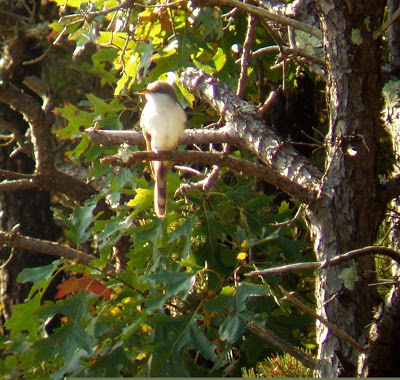
I chose not to bring my iPod and earphones on my run this morning along the river so that I wouldn't miss any new birds singing. This time of year it seems like I hear something different on each run. Sure enough, amid the usual suspects--house finch, goldfinches, titmouse, cardinal--I heard the dry trill of several chipping sparrows. They like to hang out near my office, so I imagine I'll be hearing more from them. Upriver along Route 105 I was delighted to hear a red-bellied woodpecker in someone's yard. Haven't heard one of those in a while. But best yet was hearing a bird calling "cu-cu-cu-cu-cu-cu" in a wooded stretch along Molyneaux Road as I headed downhill toward the old fish hatchery. I stopped in my tracks and fruitlessly peered into the trees. I knew that sound: black-billed cuckoo. Along with its cousin the yellow-billed cuckoo, it's known as the rain crow.

The black-billed cuckoo is a fairly common bird around here, but very shy and so seldom seen. I've followed its distinctive call--a sort of breathy, bell-like, monotonous intonation--through the woods for a long time and never seen the bird. Other times, one will appear right in front of me for a minute or two but never make a sound. They come and go with silent magic. The bird I heard this morning is a remarkably early arrival to the area, but this spring everything has been early. Yesterday at the Arboretum I saw a caterpillar tent already crawling with tiny caterpillars. Caterpillars, especially tent caterpillars, creep me out. The fact that they come from something that looks like it was made by a spider doesn't help. So I particularly enjoy seeing (or even just hearing) a cuckoo, because cuckoos love to eat caterpillars. They can chow down a tent full in one sitting. My husband and I have stood ten feet away from a cuckoo while it was engrossed in eating its way through a bunch of caterpillars on an apple tree. Good bird.

The cuckoo of cuckoo clock fame is the European common cuckoo. I distinctly remember hearing one sing in Scotland when I was a child on a visit there with my grandparents. While the bird itself was rather plain, I was excited to have found it, because it sounded just like the clock in my grandmother's kitchen: "cu-coo, cu-coo." Our cuckoos are supposed to warn of imminent rain, hence the nickname. Thankfully, the bird's prediction didn't seem to apply to today, which remained gloriously sunny till late afternoon. The week ahead is supposed to be a wet one, though. Apparently when cuckoos get wet they sometimes have to air out their soft feathers by spreading out their wings in the sun like a cormorant. So it's not that the rain crow likes rain--he's just understandably sensitive to it.

Invisible bird
intones his warning of rain,
stops me in my tracks.

Yellow-billed Cuckoo photographed by me on Cape Cod in 2003.

April 24: Crows Chasing Things

Kristen Lindquist

Wherein my fascination with crows continues... Early this morning I drove to Augusta to co-lead a bird walk at the Viles (formerly Pine Tree State) Arboretum in Augusta as part of the Friends of Baxter State Park's annual meeting. On the 45-minute drive, I saw a tom turkey in full display on top of a hill in Union. I wished him luck. I also watched a crow in hot pursuit of a mourning dove. As I drove along, it chased the petrified dove across three lawns. I couldn't figure out what was going on there.

At the Arboretum I enjoyed a brief but lovely walk on a warm, sunny Spring morning with a nice group of people. Tree swallows swarmed the bird box area behind the Arboretum offices, filling the air with their liquid songs. Love was in the air. Literally. Each box sported a pair of birds. I flushed a hen turkey near the rock garden. Ruby-crowned kinglets sang their surprisingly loud and complicated songs. We had close-up views of an obliging pine warbler, whose yellow head and throat caught the light. For the first time this spring I saw and/or heard five species of sparrow: chipping, Savannah, song, white-throated, and swamp. A Virginia rail responded to a recording by calling back from amid the cattails. I watched a pair of crows sweetly preening each other. Later, I observed two crows (the same ones?) dive-bombing a vulture, a much larger bird. A good morning.

On my drive home at day's end, I spotted a harrier dipping low over a field... being harangued by a persistent crow. At least crows seem to be democratic about what they chase. Drive away anything that is not a crow seems to be the rule. I wanted to capture that inclusiveness in today's poem. It might not seem very interesting, but it's just subtle. Like a crow.

Crow chases a dove,
crow chases a harrier,
crows chase a vulture.

April 23: Crow Chorus

Kristen Lindquist

Crows. I see them every day and they're always up to something. I could write a whole blog just about crows. Last night as dusk was creeping in around the edges of the trees, a murder of crows was clamoring and hollering up on Mount Battie. With my binoculars I could see birds flying just above the interlaced branches of the pine trees on the craggy mountainside. Crows swirled around, back and forth, in a caw-caw-caw cacophony. A couple of crows flew out from behind my house as if interested in joining them. They must have heard enough to figure out what all the fuss was about and decided it didn't suit them, because they soon turned back around. But the neighborhood crows are obviously homebodies, because it seemed like every other crow in town was up on the mountain yelling.

For some reason I don't think they were harassing another bird. Often the presence of an owl or hawk will provoke that type of gang response, but their flight patterns didn't seem directed at something perched in one spot or flying. A few vultures were soaring near them, so maybe it was as simple as the discovery of something large and dead in the woods up there. But I had the feeling that maybe they had found a fox wandering around and were following it. A friend who lives at the base of the mountain said she's seen them do that there. I'll never know for sure, but I certainly enjoyed puzzling over this latest crow mystery as I stood on my front step in the waning light. Ongoing eruptions of caws continued from the rocky slope of Mount Battie long after I went inside. Even my old cat seemed to pick up on it, pricking her ears. I wonder if the sound triggered some primal instinct in her, if crows used to chase wild cats through the woods in ancient times, dogging them like they do foxes.

Crow cacophany--
something's happening up there.
It's always something.

April 22: Earth Day

Kristen Lindquist

This Earth Day I've spent a lot of time watching the sky. The cumulus clouds rolling in from the west to heap up against Mount Megunticook have been dramatic. Puffy piles of water vapor accumulating and dissipating fill the horizon in ever-shifting arrangements. Today would have been a good day to lie out on a lawn somewhere and observe cloud patterns. I see the Sphinx in the cloud below, or maybe a griffin. Poised next to a cabbage. A good day to let the mind wander a little bit.


How vapor becomes
a griffin poised on pine trees:
clouds, a relaxed mind.

April 21: Broad-winged Hawks

Kristen Lindquist

Three-hundred ninety-seven broad-winged hawks were counted at the Bradbury Mountain hawk watch today. That's a lot of hawks. That's a good portion of the 653 total that have been seen from the hawk watch this month. Derek Lovitch, the official counter today, commented with his report that small kettles of broad-wings were moving through early and very high, visible only against the clouds.

I wasn't outside much today, so didn't have an opportunity to look for any hawks. (Yesterday I saw, perched roadside, my first and only broad-wing of the year so far.) But I could see enough out the window to know that big, fluffy, rain-saturated cumulus clouds were rolling through all day, at one point a bit thunderously. Knowing now that hundreds of hawks were swirling overhead while I worked away at my desk is a bit disconcerting. All that motion, all those feathered bodies being pulled northward, and I wasn't a part of it in any way.

During Fall migration, hawk watchers migrate to Mexico's narrowest isthmus. Because broad-wings and many other raptors don't like to fly over water, they don't fly over the Gulf of Mexico like many other migrants heading for Central and South America. Instead, they stay above land, funneling down the body of Mexico on their way south. The birds obviously become most concentrated where the country constricts. Hawk watchers in Veracruz, a city on the Gulf side of the isthmus, have counted 100,000 broad-wings in a day, and 2 million during a season. Pretty much all the broad-wings in the world pass over this point. A small portion of those hawks traveled over Bradbury Mountain south of here today, and a portion of those traveled over my head as they followed the ridges of the Camden Hills. It was going on all morning, and I missed it. But I love thinking about it, trying to get my head around the incredible miracle of that journey.

Kettles of broad-wings
carried by rain clouds northward.
And I, unaware.

April 20: Comic Relief

Kristen Lindquist

I had to get up earlier than usual this morning for a meeting, and if you know me you know that unless I'm getting up early to go birding, mornings are not my best time. It takes me awhile to ease into my day. This isn't a simple matter of caffeine, either, because I haven't been a coffee drinker since college. I've always been a slow starter. So at what felt like the crack of dawn this morning, when the rising sun had just set fire to the treetops across the river, I sat at my desk groggily checking e-mail. Suddenly, a crow flew across the back yard carrying something white. I could hear a small gang of jays yelling. Then another crow plopped down on the lawn right outside my window with something white in its bill. They must have raided my neighbors' compost bin. I couldn't tell what the two crows had snatched, but the snacking crow's bill was covered with it. The crow looked like it had dipped its face in a bowl of frosting or whipped cream. Despite my morning grumpiness, I couldn't help but laugh aloud. Alas, when I stood up to get a better look, I inadvertently scared the bird away. When I got home this evening, there was no sign of anything white and messy back there, so it must have come back for its treat after I left. Most days I'm just thankful if there's something to get me going, and if it's something that makes me laugh, all the better.

Morning's first, best joke--
pilfering crow's white-splotched beak.
Laughed myself awake.

April 19: Sun-shower

Kristen Lindquist

This afternoon while running an errand I got caught out in a torrential downpour. I got soaked in about 60 seconds. It was rather invigorating. By the time I got back to the office, the rain had passed through. The sun shone, and vultures soared ecstatically in the blue sky, wheeling over Mount Battie on gusts of wind. And there I was with wet hair dripping all over my desk. But soon enough, another clump of clouds rolled in, and it began to rain again--though the sun was still shining, the western sky a wide scrap of blue. As we  were leaving work, a faint but full rainbow arced over the mountaintop, briefly bridging it with rapidly fading colors.

From the movie "Kurasawa's Dreams" I learned that this kind of sun-shower is the foxes' wedding day. If you happen upon the ceremony itself, as happens to a boy in the movie, you will never be able to return home. (That's just one haunting "dream" in this beautiful film.) I always think of it when experiencing this weather pattern, the scene of the fox bride and groom upright and dressed in ceremonial clothing, marching through the trees with their wedding procession, one of them turning to look right at the boy spying on them...

Interestingly, in checking it out just now as a bit of Japanese folklore, I discovered that the theme of a trickster animal getting married during a sun-shower is common all over the world. For many cultures it's foxes, but in Bulgaria, apparently bears get married, and hyenas in Kenya. In other places, devils or other evil spirits get married. What's up with that? That's the kind of thing I would have loved to have studied back when I was taking folklore classes in grad school.

In any case, foxes in this neighborhood should have done their "marrying" a couple of months ago, so I'm not worried about stumbling upon their wedding. What does worry me, however, is that some night I'm going to hear a vixen screaming in the woods and drop dead of a heart attack.

Sun shining through rain--
fading rainbow a bower
for foxes' wedding.

April 18: Hidden Treasure

Kristen Lindquist

Most of today was spent sitting at my desk writing, but much of that "writing" time has consisted of looking out the window at my back yard and the river. Not much going on back here. A neighbor's cat meandered through. A fisherman walked along the riverbank, casting a few times without much conviction into the slow-moving water. Some blue jays hung out for a while, yelling from the maple tree. A couple of mallards flew upriver. And one or more squirrels made several passes through the yard, apparently searching for the buried treasure of last year's acorns. He, she or they make little pits in the lawn in this occasionally fruitful quest.

When I undertook my back-breaking Day of Raking Hell last month, I uncovered a lot of acorns under the dead leaves. Today the squirrels were taking full advantage of the acorn-studded lawn, criss-crossing here and there, stopping to sniff each leaf and lump. There are a lot of squirrels in my back yard--I've counted three pairs at one time, and almost always see at least one when I look--but I've never stopped to think about what they're living on. We don't have bird feeders (thanks to the squirrels), and other than a couple of oaks worth of acorns, there's not a lot else that seems edible this time of year. Once in a while I'll set an overripe tomato or squash on an old stump near the shed and am later gratified to find shreds of evidence to indicate the meal was enjoyed. There must be other things in the neighborhood they're finding to nosh on, because they're clearly thriving.

Just now, one has looped its way over the grass, tail a graceful, dipping plume. Another has just hopped up on the stump, holding something to its mouth. Now it's hopping up the path to the back porch. Coming to borrow a cup of sugar?

Fall's stashing, caching,
has yielded this: old acorns
unearthed like treasure.