Contact ME

Use the form on the right to contact me.


123 Street Avenue, City Town, 99999

(123) 555-6789

email@address.com


You can set your address, phone number, email and site description in the settings tab.
Link to read me page with more information.

IMG_1267.jpg

Book of Days

BOOK OF DAYS: A POET AND NATURALIST TRIES TO FIND POETRY IN EVERY DAY

Sign up on the Contact Me page

July 3: Phoebes in the Trees

Kristen Lindquist

After finishing what I can hardly even call a run (one-mile, doctor-prescribed sort of rehab stint as I repair a back muscle), I stretched and did my strengthening exercises on the back lawn. Primarily solar-powered, I spent much of my time just lying on my mat admiring the patterns of leaves overhead and recharging in the morning light. Birds sang--blue jay, phoebe, song sparrow. A waxwing and what I think was a flicker passed silently overhead. An osprey's high-pitched calls carrying from Camden Harbor punctuated the calm. I savor such moments with my regimen completed and some time to fully relax and enjoy what's in front of me. For a few moments, at least, I feel strong and serene.

In this mood of mellow alertness, my mind sees everything as aesthetic, as something to note. Two phoebes darting overhead like living shadows amid the oak leaves, tails wagging, is not an unusual sighting. But because I observed them while happily lying on my back under the perfect blue sky of the first day of a long weekend, they seemed like something special--the ordinary transformed simply by the mood of the observer. Two phoebes, clearly a mated pair, fly-catching together on a summer morning. And nothing required of me but to lie there absorbing sun and watch them.

As I type this, one of those phoebes has perched on my clothesline, as if to assert that it's today's haiku inspiration, and a robin sings his cheery song somewhere down by the river. I have a feeling this is going to be a wonderful day to be alive. But aren't they all?

Phoebes in the trees,
sunlight, and nearby, ocean--
a day to savor.
July 2: Wood Lily

Kristen Lindquist

This afternoon I had lunch with an old college roommate whom I hadn't seen for twenty years. After lunch we walked up Beech Hill so I could show off "what I do" and hopefully spot the black vulture that my friend Brian photographed there this morning. As we made our way up the trail where it skirts the blueberry fields, I was a bit startled to see patches of fully blue, ripe blueberries. From the road up to the summit of the hill, the view of the blueberry fields broadened, with a wide backdrop of ocean and islands, from Monhegan to our far right panning left over Vinalhaven, North Haven, Isle Au Haut, Mount Desert, all the way to the knob of Blue Hill back on the mainland. And behind us, the beautiful green carpeted curves of the Camden Hills undulated through the countryside on one of those afternoons when I felt particularly grateful that this is my home.

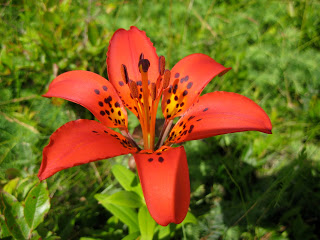
A towhee chinked in the bushes, and a silent Savannah sparrow flitted across the path. And in the fields wildflowers were blooming among the blueberry plants, including a Beech Hill specialty, the wood lily. The wood lily is an uncommon wildflower found scattered throughout the preserve's open fields. Beech Hill is the only place I know to find it. Despite preserve guidelines asking people not to pick native vegetation, every year there are always a few idiots who can't resist or who mistake it for the more common roadside variety day lily. "What's this beautiful flower?" they ask. Something you shouldn't have picked, we want to reply. Each flower is a rare and precious thing, a work of art.

The bright orange flower is a sort of flag that the blueberries are ripening, as it always seems to blossom just before the berries are ready. By the time of the harvest, the fields have erupted with lilies. I saw just a few lilies here and there on the hill today, the petals like flames amid the waving grass and other wildflowers. I think I may even have seen one raising its head on the sod roof of Beech Nut. Soon I know more will be brightening the fields, signaling to humans, birds, and animals that it's berry time.


Watchfire of July--
flame of the wood lily licks
the ripening fields.


July 1: Resurrected Chickadee

Kristen Lindquist

Talking to a co-worker today I heard a thud behind me. "I think a bird just hit the window," she said. My heart thudded and sank.

Something about our office windows seems to invite bird strikes. I've tried taping falcon silhouettes on the glass and hanging strings from the tops of the window frames. What's worked best has been a strip of blue flagging taped the length of the window to at least create movement and a bit of three-dimensionality so the bird doesn't see sky where there's really only hard glass. The window the bird hit today didn't have blue flagging, but I thought it was safe because my little bird feeder is stuck to the middle of it. Apparently that wasn't enough of a distraction.

Dreading what I would find, I went outside. On the ground, wings and head askew, was a chickadee. It's almost always a chickadee for some reason, though the windows have also stunned or killed a red-eyed vireo, a yellowthroat, titmice, and a song sparrow. I gently cupped the bird in the grass and smoothed its wings, trying to assess the damage. Its bill was agape as it panted, in shock. I knew my holding it would only panic it more, so I placed it in the shade under a bush and hoped for the best. It couldn't raise its head, so I worried it would soon die, but a little later I looked out the window to check on it, and while it was still where I'd left it, its head was up and beak shut. About ten minutes later as I left for an appointment, I checked one last time. A song sparrow was hopping toward it. What was that about? Did it see the smaller bird as a territorial invader or was it simply curious? Whatever the case, I was relieved to see the chickadee respond by flying away. It seemed to be ok, because it quickly disappeared into the trees to live a little longer.

Glass an illusion
of sky, tricking chickadees
into the hard truth.

June 30: The Poetry of Dragonflies

Kristen Lindquist


I've been told by a very reliable source that this handsome fellow is a male Celithemis elisa, or Calico Pennant. I came upon him today while tromping around the milkweed patch at my office trying to photograph butterflies. I saw my first monarchs, a red admiral, and a few things I couldn't identify, but this guy was the only thing that would hold still for my camera. The Calico Pennant first emerges in late May to early June and is apparently very common throughout the summer here along the Megunticook River. It's also easily recognizable, as its all-over red appearance is noticeable at a distance. Right now several of them proudly wave their red selves above the overgrown lawn. 

I know next to nothing about dragonflies, but several birder friends are also avid odophiles. (These same friends are also very good at identifying butterflies--I guess once you start paying attention to one set of flying things, you just start noticing the others.) I like to watch dragonflies flit and dart through the air, wings shimmering, iridescent bodies glistening like jewels. But my real interest in them is not as a naturalist or observer, but as a poet. Check out these common names of some dragonflies found in Maine: Ebony Jewelwing, Violet Dancer, Lilypad Forktail, Sedge Sprite, Sweetflag Spreadwing, Spatterdock Darner, Unicorn Clubtail, Riffle Snaketail, Stygian Shadowdragon, Ringed Boghaunter, Seaside Dragonlet, Cherry-faced Meadowhawk, and Black Saddlebags. They sound like creatures from a fantasy novel! Naming really doesn't get any better than this unless you're an elf or fairy.

Jewelwing, sedge sprite--
dragonfly or elf, your wild
Maine magic shimmers.


June 29: Death and Life

Kristen Lindquist

Driving to an errand in Rockport this afternoon, I saw a dead grey squirrel on the side of the road. Not an unusual sight, and it's not like there's a shortage of squirrels in the world, but I'm always saddened to see any road-killed animal. I gave some moments of thought to the short but probably lively life of the now-squished squirrel and made a silent wish that its body would at least now make a positive difference to the life of some crow, vulture, or fox. 

On my return to the office, I passed by a house with lots of bird feeders hanging in the yard. One tube feeder was completely obscured by the furry body of a grey squirrel curled around it, its tail waving like a plume. I had to laugh. This squirrel was very much alive, doing what squirrels do best. It was somehow reassuring to see. Life goes on, even as we are confronted with deaths large and small on a daily basis.

Draft of passing car
flips the dead squirrel's tail. Live
squirrel flicks his too.

June 28: Milkweed in Bloom

Kristen Lindquist

At my office we don't mow most of the lawn, instead allowing the native vegetation to take over in a sprawling but natural way. A good portion of it hosts a rather dense patch of milkweed, which has just begun to bloom. We tend to stop paying attention to what we see all the time, so I hadn't realized the milkweed was blooming until I walked from the office to my car this afternoon after a torrential rainstorm had passed through. The humid air was redolent with a sweet fragrance that literally stopped me in my tracks. What was it? I looked around the thicket of plants I had just walked past, and the only flowering plant nearby was milkweed. Ordinary milkweed. I sniffed a cluster of the unprepossessing pink blossoms... and that was it! I had no idea milkweed could smell so wonderful.

What I do know about milkweed is that monarch butterflies lay their eggs on the plants, and the resulting larvae feed entirely on milkweed. Milkweed sap is toxic to what might eat a caterpillar; by eating milkweed leaves, the caterpillars become toxic too. I've seen a merlin catch a monarch and spit it out--clearly, the butterflies don't taste good either. So monarch and milkweed have a close relationship, with the aromatic plant being essential to the early life stages of the butterfly, as well as increasing the insect's chances for survival against predators. And I'm sure the monarch plays a role in pollinating the milkweed in turn.

After the rainstorm
milkweed sends perfumed love notes
to the butterflies.

June 27: Repetition

Kristen Lindquist

The red-eyed vireo may repeat his song 20,000 times during the course of a summer day. I was thinking of that as I heard one singing off in the trees, as I picked what felt like my 20,000th strawberry in my friend's garden today. We've had perfect strawberry weather this June, and my friend's patch was overflowing. She needed help. After enjoying a breakfast of Belgian waffles with strawberries, the two of us picked 23 quarts over several hours--punctuated, of course, by a lunch of yogurt, honey, and... yes, strawberries.

There's something lulling about repeating a gesture over and over, even as your back and legs ache. It was warm but not overly sunny, either, which made it a pleasure to be out doing something productive in the garden. And of course, knowing I was going to take home some of these luscious fruits was added incentive. I lost myself in the activity, only occasionally (because I'm a birder and can't help it) becoming aware of birdsong in the surrounding woods. The red-eyed vireo, for example. Or the robins nesting nearby. Or a bluebird. Once I looked up and saw a hawk circling overhead. The setting was bucolic--peas in bloom, corn almost knee-high, terraced perennial beds in full bloom, butterflies fluttering over fields spangled with wildflowers. Who could call this work, this crawling over strawberry runners, squatting in the dirt, plucking ripe berries from amidst the foliage and dropping them with a plunk in a pail?

The real work started when I got all those berries home. I dropped off a bowlful at my parents' house, and gave away as many as I could to my neighbor with many children--those growing bodies need the vitamin C. But even after putting some aside for my cereal over the next couple of days, I still had a heap. These I rinsed, spread out on a towel, hulled one by one--the repetition less enjoyable than the picking but meditative nonetheless--and bagged for the freezer. Two quarts that will undoubtedly form the base of some wicked good smoothies later this summer.

For each berry picked,
vireo sings one more phrase
in praise of summer.

June 26: Backyard Birds

Kristen Lindquist

After mowing the lawn today, I did something unusual for me. I sat on the back step in the sun and... well, that's it. I just sat on the back step. For about ten minutes I did nothing but just sit there and live in the moment. My cat, who is strictly an indoor cat occasionally allowed supervised visits onto the porch, came over and, instead of trying to make her usual escape attempt, curled up in my lap. Apparently she wanted to live in the moment too. She purred and dozed, while I looked around and thought about how much I love my back yard.

Back yard, how do I love thee? Let me count the ways. I love the ever-present rushing music of the river that passes over your feet. I love the canopy of oak, beech, ash, and maple leaves that surround you, leaving just the right-sized opening for sky and sunlight. I love the frilly fans of ferns that border your edges and the tall goldenrod along the porch steps. I love your view of my neighbor's orange day lilies. I love how you keep my flowers healthy, even the wild ones. And I love how the combination of water and tree cover brings birds into your sheltered embrace.

If you don't go looking for birds, sometimes they have a way of finding you. While I sat there enjoying my yard in all its early summer greenery, I heard the following:
cardinal whistling up a storm in the neighbor's yard
squalling group of crows upriver
broad-winged hawk high overhead
pileated woodpecker cackling somewhere downriver
loon calling in flight
warbling vireo moving through the trees above the river
several robins singing throughout the neighborhood
song sparrow across the street
hummingbird squealing through the yard, hopefully on its way to my bee balm

I've found fewer birds than that while out actually looking for them! And my cat was oblivious to it all.

Sometimes sitting still
turns out to be the best way
to hear birds, here, now.

June 25: Return of the Merlin

Kristen Lindquist

For the fourth time in a week I heard a merlin calling outside my office. The first couple of times I heard that fast, high-pitched call, I thought it was a blue jay pretending to be a merlin. The third time, I saw the bird flying. It was indeed the small falcon, not a cheap imitation (or a jay). And today, when I proclaimed that I could hear the merlin again, my co-workers rushed to the door and we all got to watch the bird, which had very conveniently perched in plain view atop a snag at the end of our parking lot.

Despite all his yelling, he sat quite calmly in the dead tree, preening and looking around a bit before flying off. He seems to make a ruckus when dogs are around, I've noticed. But then again, it doesn't take much to rile up a merlin. They're very vocal birds on territory, which makes me wonder if this bird has a nest somewhere nearby. They're also very fierce, diving at just about anything that annoys them--even a much larger bird like a crow, gull, or peregrine. If this bird has a nest in the neighborhood, it's not too near though, because I've never seen him actually chasing another bird. I think he just shows up to yell a bit, let everyone know who's boss, and push the limits of his controlled air space.

Even from afar
we can see hooked bill, fierce gaze--
merlin on patrol.

June 24: Young Woodpecker

Kristen Lindquist

Yesterday I heard a red-bellied woodpecker calling outside the office. This afternoon I happened to spot one hanging out on a tree about 20 yards away from the window. Except for its black and white checked back and wings, this bird was dull brown all over, with just the faintest wash of red on the back of its dusky head--obviously a juvenile, probably a female. This is a species that only made a serious incursion into Maine five years ago, so it was exciting to see living proof that at least one breeding pair nests in my neighborhood. And here she was, on her own, a youngster loosed into her first summer.

I sat and observed as she loafed on the tree trunk in one place for about 20 minutes, a typical lazy teenager. For a while she seemed to contemplate the tree trunk, looking at it from various angles. Then she wiped her bill on the bark for a minute or so. She picked a few bugs off the trunk. Then she spent about 15 minutes casually preening. Chickadees hopped around her, and a flock of waxwings passed through the trees. A catbird sang a few odd phrases, mewed, then flew into the woods. But the young woodpecker clung to the side of the tree, her stiff tail feathers bracing her against the trunk as she pecked and smoothed her feathers. What does it feel like to have real feathers for the first time?

Eventually she flew a few trees closer, to a shad bush laden with berries. She began acrobatically eating some of the berries, looking a lot like a waxwing as she twisted among the branches, craning her neck to nab the plump red little fruits. Duty called, so I left off watching at that point, but I felt privileged to have been witness to half an hour in the life of this young bird.

Woodpecker pauses;
I pause to watch--a young bird
preening new feathers.

June 23: Bee Balm

Kristen Lindquist

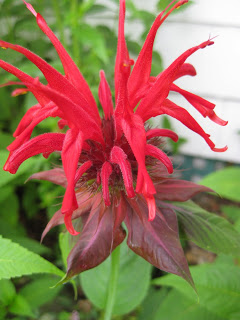
This summer the bee balm has become King of the Garden. A self-propagating perennial, each year it pops up in different places and in varying density. This year, however, it's outdone itself. Usually the tallest stalks are just visible at kitchen windowsill level. Today I noticed that the tallest plant is gaining on the top of the window, and its red buds haven't even fully opened yet. It's sort of like an out of control, seven-foot tall adolescent boy. And there aren't just a few plants scattered here and there--there are dozens. This is one patch of happy, dominating flowers.

The bee balm was given to us as a house-warming gift five years ago, and I was thrilled to receive it because I know it's a favorite of hummingbirds. My grandmother always had a patch, along with a yearly mass of nasturtiums, half a dozen hanging fuchsias, and about as many hummingbird feeders. Dozens of ruby-throated hummingbirds screamed around my grandparents' house all day long. Things are a bit less dramatic at our house. When the bright red bee balm blooms, I occasionally watch one hummer at a time visit the flowers while I'm eating at the kitchen table. A small excitement, but one I look forward to nonetheless, especially that moment when the male hovers in front of the window, flashing his ruby-colored gorget. (That's his throat, lest you think I'm being obscene.)

With this year's plants stretching more than halfway up the window, we should have a pretty good view when the hummers arrive at our one good nectar station. I've heard them buzzing around the neighborhood, but the only other flower blooming that might have attracted them thus far is a lobelia that's not visible from inside the house. So we have high hopes for our super-tall, super tempting, majestic bee balm.

Allure of ruby
flower draws the ruby-throat,
living gem itself.