Contact ME

Use the form on the right to contact me.


123 Street Avenue, City Town, 99999

(123) 555-6789

email@address.com


You can set your address, phone number, email and site description in the settings tab.
Link to read me page with more information.

IMG_1267.jpg

Book of Days

BOOK OF DAYS: A POET AND NATURALIST TRIES TO FIND POETRY IN EVERY DAY

Sign up on the Contact Me page

November 11: Souffle

Kristen Lindquist

As part of the ongoing sequence of fetes and festivities here in Houston, tonight we enjoyed dinner at Tony's, reportedly one of the best restaurants in the city. The company was charming--people in the South really are very warm and welcoming--and the food exquisite: sushi tuna with avocado, Caesar salad, red snapper Sheridan, and the piece de resistance, four huge Grand Marniere souffles. The souffles were carried in with some ceremony, held aloft so we could all admire them. They looked like baker's hats, only edible. I've never seen anything like them. After some oohing and aahing, the souffles were cut open and served. How to describe the experience of eating the dessert? The sugary meringue-like foam with the custard filling was an incredible treat, as this whole whirlwind trip has been. I feel so grateful for each experience my sister and I have shared together over the past two days here--I've really tried to savor each one, like each bite of an excellent dessert.

Glorious souffles
risen, baked to perfection.
Enjoy your dessert.
November 10: River

Kristen Lindquist

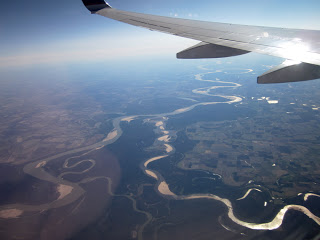
Flew from Boston to Houston this morning with my sister. Snoozed a bit and when I awoke, there was an amazing river winding across the landscape out the plane window: S-curves and crescent-shaped ox-bows and sand bars--even the texture of waves on the water's surface was visible. This unexpected perspective on a river was mesmerizing, and I felt vaguely disappointed when we flew past it. I don't have any idea where we were or what river it was.

Seen from an airplane,
the river's a living thing
snaking through green hills.

November 9: Fall Voices

Kristen Lindquist

Each morning there's a certain sequence of sounds I expect to hear. The very early morning sound of our neighbor's garbage truck groaning down the hill and braking at the corner as he heads off to his day's work. The creak of my husband's office chair as he ekes out some writing (and news reading) time before I get up. The alarm. The high-pitched yapping of our neighbor's chihuahua, which maintains the same energy and decibel level no matter if it's 6 a.m. or 11 p.m. Birds landing on the window feeder in the kitchen. The school bus at 8 a.m. on the dot, picking up the kids across the street. When the windows are open, the constant rush of the river out back... The regularity of these sounds makes even the most annoying ones somehow comforting. All is on time and as it should be.

This morning as I was getting ready for work, I heard over the sound of the shower what I thought at first was the neighbor's dog barking yet again. Then I realized the sound was a little different--less "yip yip yip" and more like a loud, murmuring conversation: the honking of geese. Their calls grew louder as they flew downriver behind the house, their bodies visible through the (mostly) bare branches. I'd been seeing a flock upriver at work this week, grazing near the Seabright Dam. Were they finally leaving? I felt a sudden pang at the thought.

But then, just as I began to write this, I looked out the window and saw the flock slowly flapping its way back upriver, where they landed just out of sight. Apparently this unseasonably warm, beautiful day has convinced them to stick around a little longer. One more day, at least.

Sounds of a morning:
geese conversing, heading south.
It must be autumn.

November 8: Seeing Red

Kristen Lindquist

Late fall the landscape begins to wither and fade. While trees are still hanging onto a surprising number of leaves, they're duller, burnished browns now. Grasses are dried up, flowers gone. So as I drove to Augusta this afternoon I was surprised to see nature's most vivid color suddenly blazing forth. Red! I put on the brakes as I came upon a small blueberry barren, its brilliant crimson emphasized by remnant patches of snow lingering in a shady corner. Is there any red more breathtaking than an autumn blueberry barren?

Blueberry barrens in Hope, Ragged Mountain in background
Maybe... Heading up Route 17 I was then struck by another vision of red: amid the dried-up reeds and blown-out cattails of a small wetland, a winterberry bush shone forth, its berries glowing in the sunlight like Rudolph's nose (as seen in the traditional holiday special with Burl Ives). Further along, more clumps of berry bushes popped out, exclamations along the way.

The sun was sinking low as I returned from Augusta a few hours later, washing the trees with that last rich light of the day. The mellow brown leaves were transformed into a breathtaking coppery bronze. With trees lining both sides of the road, it was like driving through a corridor lit by a living, reddish glow, enhanced all the more by a crisp, clear blue sky backdrop containing the almost full moon. Now the winterberries blurred together into a haze of color as I drove past. The scarlet of the blueberry fields deepened. If I were an artist and tried to paint with those reds, it would look unreal, unnatural. But there I was, surrounded by them. Real life red, almost pulsing.

Before all goes white,
red appears: blueberry fields
and winterberries.

November 7: Misty Moon

Kristen Lindquist

Thanks to the time change, when I left work this afternoon, dusk was already falling. The waxing moon was rising over Mount Battie, slightly blurred by a frosty mist. Misty moon. I was reminded of a key scene in my favorite book, the 11th century Japanese classic The Tale of Genji (which I've referred to in several other posts-it's a poetic touchstone for me). Made restless by the beauty of the misty moon, the book's hero, Genji, sneaks around the women's wing of the royal palace looking for romance. He chances upon a mystery woman whom he overhears admiring the moon and ends up spending the night with her. That's how things happened in that time and culture.

The mystery woman is thereafter referred to as Oborozukiyo, Night of the Misty Moon. Turns out she's a princess, the crown prince's wife-to-be, and the sister of Genji's greatest political enemy. This combination of poetry and forbidden love of course makes her all the more irresistible to Genji, whose continued pursuit of her sets in motion the series of political events that eventually lead to his exile. It's one of the many romantic vignettes exquisitely captured in the book, and I've always been especially drawn to it--perhaps because I too can remember being similarly moved by the poetic beauty of the misty moon, way back in my reckless youth.

Misty moon rising:
romantic memories blur
under Genji's moon.

November 6: Desire Lines

Kristen Lindquist

Every now and then in a conversation or presentation, some phrase or concept will resonate with me. This past weekend at the Juice Conference I attended a session "Connecting People to Places," about how communities can create easier ways for people to get to where they want to go by foot or by bike. Someone from Portland Trails offered several examples of how his organization has makes use of "desire lines"--the beaten-down paths we make when we commonly use a particular, informal route to get from one place to another.

Every community has these desire lines. They track our natural patterns of movement, as opposed to the routes that are laid out for us in the form of sidewalks, streets, and formal trails. If you drive around with the concept in your head, you'll start noticing them: the path that gets you from a parking lot to a street through a little section of woods; a shortcut across the park; that easy cut-across from the school to the well-traveled street.

Portland Trails takes note of these desire lines in the city and tries to make them into formal paths, to both encourage safer foot traffic and potentially transform a trampled and eroding dirt path into something more aesthetically pleasing to the community. I've just got the phrase stuck in my head because I'm a poet and am drawn to something that uses a strong word like desire to denote something so practical and (literally) grounded. The metaphorical potential is huge.

Desire lines: those paths
where human need wore its way
to what it wanted.

November 5: Downtown falcon

Kristen Lindquist

After being alerted at least three times by a fellow Camden birder of various sightings of a peregrine falcon that regularly perches atop the steeple of the Baptist church, I finally saw it for myself.

This morning before 8:00 I found myself standing outside the Camden Opera House as a volunteer for a conference. Looking across the Village Green toward the church, as a small flock of pigeons circled overhead, it occurred to me that now would be the perfect time for a falcon to show up. So I kept one eye on the sky while carrying out my volunteer duties. The church clock rang eight. A silhouette of a largish bird perched atop the bank caught my eye, but no, it was a (very vocal) crow. More people passed, conference attendees, dog walkers. But I kept watching, I had faith.

And then, there it was. A pair of crows sounded the alarm as a large falcon flew overhead, its profile distinct against the blue morning sky. From its size, I'm thinking she was a female. She made a few passes. I excitedly pointed her out to a pair of random conference participants. She dipped behind the church and circled the steeple. I hoped she would perch on the steeple, but not this morning. She was there and then gone, leaving me standing there on the sidewalk with a foolish grin on my face for several minutes.

Peregrine fly-by
right here, downtown, this morning--
I finally saw it!

November 2: Flies

Kristen Lindquist

This morning I attended a meeting in the Camden Snow Bowl lodge, an old A-frame that turns out to be the perfect habitat for those big, lazy house flies that literally come out of the woodwork this time of year. The side of the building that faces the ski slopes is all windows, and I couldn't help but notice hundreds of black specks crawling on the inside surface of the glass. When I exclaimed in horrified amazement to a staff person there, she directed my attention to a window in the opposite peak, over her office. It was covered with masses of flies, so many that they obscured the view. We joked that the place needed 20-foot strips of fly paper.

Throughout our meeting I kept catching, out of the corner of my eye, the sight of flies moving--a sensation similar to seeing stars, only they didn't go away. Luckily, most of the flies were far above us. But every now and then one would land on one of us or the table and just cling there in a slow, creepy way. I could have easily caught one with chopsticks. I kept feeling them land on my hair, whether they were there or not. The creepiness went up a notch when a big ventilation fan that had been humming loudly throughout our meeting turned off. Suddenly we could all hear the buzz of hundreds--maybe thousands--of flies...

White noise of black flies
in crawling constellations
above us: wall's gift.

November 1: Ducktrap Salmon

Kristen Lindquist

One great thing about my job with Coastal Mountains Land Trust is that every now and then they let me out of the office to spend time on one of our conservation properties. Our Ducktrap River Preserve has long been one of my favorite places.

Late this afternoon a group of us gathered there around fisheries biologist Peter Ruksznis to learn some of the mysteries of salmon migration and spawning. Peter had that day carried out his survey of salmon redds in the river, and as he'd expected, he found none. This was sad, but not unexpected--five years ago, he'd also found none, and this would have been the next generation of that spawning year. However, other "cohorts," or multi-generational runs, have fortunately been more successful, making the Ducktrap the only Maine river with a natural run of Atlantic salmon. (All our other salmon rivers are currently stocked.) We also learned why the Ducktrap offers ideal habitat for salmon: 85% of it is permanently conserved, it's a consistently cool river (in part due to heavy forest overhanging much of its banks) with appropriate riffles, a bed that's the right texture for salmon nests, relatively few small-mouthed bass, which are voracious predators, and an appropriate amount of twists and turns
.

Salmon leave the Ducktrap and swim to the West coast of Greenland, to return four years later  to spawn. They find their home river by smell. I couldn't help but wonder how far out to sea a salmon can pick up the scent of its home waters, and what triggers are at work in that little fish brain to help it recognize where to go. It seems miraculous, really. We're talking about a tiny handful of fish independently returning to a tiny river on the complex coastline of Maine after swimming to Greenland and back.

Thinking about the miracle of the continued return of salmon to the river (just not this year) put the river in a new light for most of us--a light that was only enhanced by actual end-of-day sunlight falling heavily, brightly, onto the river and the surrounding tangle of forest.


Clean, chilly riffles
lit by filtered fall sunlight.
Here there be salmon.

October 31: The Living and the Dead

Kristen Lindquist

As soon as we got home from the gym tonight, trick-or-treaters began arriving at the door: zombies, a little monkey, a giraffe, a chef, the usual ghosts and skeletons, a bedazzled witch, and my favorite one so far, a fishing boat. The little boy who was the fishing boat had to make his way carefully to the doorway, as his very accurate, structural costume was almost dory-sized. Upon his arrival, he turned carefully around so that I could dump candy into a little lobster trap hatch on his aft end. I gave him a lot of candy because his costume was so creative. Also, because I went to high school with his father, who is now a boat captain. Good to see the nautical leaning and creativity is being carried on in the next generation.

Thinking about the next generation seems appropriate on this evening when I'm also thinking about generations past. This time of year, when the boundary between the living and the dead is thinnest, it's proper to both appease the spirits of the dead and honor them--as with the Hispanic holiday Day of the Dead, when families spruce up the cemeteries and have big picnics among the family headstones. Having had several friends and an uncle pass away in the past year, I've been thinking about "my dead" today, missing them and reminiscing about good times shared.

Children at my door--
ghosts, witches--while memories
rise of those passed on.