Contact ME

Use the form on the right to contact me.


123 Street Avenue, City Town, 99999

(123) 555-6789

email@address.com


You can set your address, phone number, email and site description in the settings tab.
Link to read me page with more information.

IMG_1267.jpg

Book of Days

BOOK OF DAYS: A POET AND NATURALIST TRIES TO FIND POETRY IN EVERY DAY

Sign up on the Contact Me page

July 14: Tastes Like Summer

Kristen Lindquist

I had the good fortune to be chosen for a focus group to critique some new menu choices and the overall service experience of Natalie's, the fine restaurant that is part of the Camden Harbour Inn. Ten of us sat down for lunch today, and three-and-a-half hours later, we got up from the table, replete.

Here's what I ate, in order:
  • A Pemaquid oyster covered with lemon air, a sort of creamy foam
  • Perfectly charred pieces of squid with Aleppo chilis, fat fava beans, a coil of fettuccine-like pasta, and olive oil
  • Haricot vert (green bean) and Boston lettuce salad with basil and red wine vinegar and creme fraiche dressing
  • Chilled lobster gazpacho with pieces of heirloom squash and a Parmesan cracker on top
  • Tender chunk of halibut in artichoke barigoule (a broth) on top of a big flat ravioli with tomato
  • Three mouth-watering pieces of rare lamb loin in a natural jus
  • For dessert, fresh peaches three ways: blistered, crepe, and sorbet (served on a block of slate)
When I ate my first mouthful of the haricot vert salad, I whispered to the woman next to me that it tasted like summer, it was so fresh, green, and garden-y. After the next course, the gazpacho, a woman at the other end of the table declared that it tasted like summer. In reality, the whole meal tasted like summer, if just because the ingredients were seasonal, fresh, and beautifully presented in a simple but somehow luxurious way. Everything was exquisite. And there we all were on a steamy July afternoon, enjoying the best food around, talking about food and what we like in a restaurant while behind us Camden Harbor and Mount Battie emerged from the fog. For a few hours I felt like I was on a mini summer vacation from work, from my every day life. It was sweet (and savory). (And the service was excellent, as always.) 

And five hours later I'm home eating a bowl of Frosted Mini Wheats for supper. 

Mouthful of summer:
green beans, lettuce, and basil,
with a harbor view. 


July 13: Summer Fog

Kristen Lindquist

This afternoon from the summit of Beech Hill you wouldn't have known there was a panoramic ocean view. Inland, you could enjoy the beauty of the Camden Hills just fine, but the bay was completely hidden behind a thick bank of fog. The southeast-facing fields rolled into woods which faded into a wall of white. I felt sorry for people from away who were missing out on what I consider one of the best bay views in the area. On the other hand, fog has a way of making a landscape more intimate by highlighting the foreground and hiding the distraction of what surrounds it. The wildflower-spangled sod roof of Beech Nut, the historic hut that crowns Beech Hill, was highly visible in all its midsummer glory, for example, as were the damp stones of its walls.

Fog mutes, distorts, and obscures the landscape in disorienting but interesting ways. Driving back to the office, I observed a small island of green rising from a sea of mist and cloud--a peak of Mount Megunticook floating within the fog. Later, in the day's last light, I was driving back from a meeting in Searsport and marveled to see the big rolls of hay wrapped in plastic looming under fog's wet shroud like guardians of the fields or strange, organic monoliths loosely arrayed throughout the mown rows. And even as I drove through patches where it appeared to be clear all around me, a blank, swirling backdrop rose in the distance where rolling green mountains should be.

Mountains disappear.
Hay bales form shadowy ranks
within fog's embrace.

July 12: Blue Jays and Blueberries

Kristen Lindquist

This afternoon I was still working in my office when our director left for home. We had the door open so the faint breeze could help dissipate the heat in our non-air-conditioned space, and I could hear him talking to someone outside. It sounded like he was telling them to go away. Curious, I went to the doorway. I expected to see a stray dog, but he was apparently alone, so I asked him whom he had been talking to. "The blue jays," he said. "They're eating our blueberries!" He then proceeded to bang some things together to scare them further off across the parking lot.

I realized then that I had been hearing the racket of blue jays outside for a good part of the afternoon without being consciously aware of what I was hearing. The jays are regular visitors, and this time of year they're always kvetching and caviling around the office in their family groups. I'd grown used to them, I guess, and had blocked the noise while I was working. They were especially excited this afternoon because they'd found an edible treasure trove--the high bush blueberries right outside our office doorway were finally ripening.

Actually, I don't think today was the first day they had discovered the berries. I think they've had their beady black eyes on them all along, just waiting for the peak moment to raid the blueberry patch. Today was the day. Thanks to the commotion, now we knew, too. After they flew off, a co-worker and I went out and picked a bowlful, missing enough berries, I'm sure, to keep the jays happy. After we went back inside, not a minute passed before I heard a jay back in the dogwood next to the berry bushes. These birds are not stupid. They keep an eye on everything.

Blue skies in July,
blue jays in the blueberries--
all as it should be.

July 11: Four Crows

Kristen Lindquist

As I started up the road on my run this morning, four crows stood together before me on the pavement. Although I couldn't see anything with my weak human eyes, something was clearly interesting them in the street. One bird was whining, probably a young bird, and I wondered if it was being given some sort of lesson. As I got closer, they hopped over to the sidewalk, still in my path. Twice more they moved just ahead of me before flying off with some complaining into the trees.

I thought of augury, the ancient Roman method of prophecy, and wondered what it meant to be confronted by four crows. The version of the traditional crow counting rhyme that I learned as a kid says, "Three crows a wedding, four a birth." While I know several pregnant young women, none are imminently due. Perhaps those crows represented the birth of a new idea, which I could use right now as I map out my August natural history column for the local paper and try to create something for the Belfast Poetry Festival with my assigned artist partner, the sculptor Beth Henderson.

If you look up the number four in numerology references, it is a positive number. So many things come in fours: four directions, four winds, four seasons, four quarters of the year, etc. Four sides creates a solid square. As I thought about them, I couldn't help but imagine those four crows together in the road as four pips on a playing card. The four of spades, a card denoting action.

Such are the things that go through my head to distract me while I run. My poet side gets the best of me, wants to read a hidden meaning in everything I see. But, to paraphrase Freud, sometimes four crows hanging out are just four crows hanging out. On my return, I passed the place where the black birds had flown into the trees. From within the dense foliage came several caws, alerting the neighborhood that the person who had seemed to chase them up the street before was back. They didn't seem overly alarmed, though. Studies have shown that crows recognize people very well, and I'm sure these crows knew me as harmless. They quieted down again by the time I got to my door.

Four crows in the road
form a square society,
no one else needed.

July 10: Gulls and Clouds

Kristen Lindquist

My mother and I went to Belfast this morning to check out the arts and crafts show on the harbor. Rain was forecast for the afternoon, so we figured early would be best. We timed it well, checked out the entire show, watched some kids play on the "beach" near the park, and even did a little shopping in downtown Belfast. While having lunch, I happened to look out the window. Between buildings I could see a wall of dark rain clouds settling over the river and harbor. They looked truly ominous. But where we were, the sun still beat down on the sidewalks and street. Its mid-afternoon rays hit the dozens of gulls that had been stirred off the roof of the old Stinson sardine plant down by the water. As the gulls swirled in the air above the river, with the glowering clouds as backdrop, they shone in the undiminished light. Made tiny by the distance, they almost sparkled, like when you're dizzy and see stars. And then, a few minutes later, the light dimmed and the rain poured down.

Last light before rain
ignites the gulls swirling high,
 each a rising spark.

July 9: Hot Cat

Kristen Lindquist

Several years ago my husband and I were visiting Saguaro National Park in Arizona. Because it was about 100 degrees outside, we watched for birds at the feeders from inside the air-conditioned comfort of the visitors' center. While there, we observed a ground squirrel doing a strange thing under the feeders. It was lying splayed out flat on the ground, all four limbs completely outstretched, looking like it had been squashed. We wondered if it was ok. It eventually got up and ran off, as squirrels do, and we eventually came across the educational sign explaining that this is how overheated ground squirrels in the Sonoran desert cool off, by transferring their body heat into the ground.

The past few hot days my cat has been doing something similar. She's been (thankfully) shunning our warm laps and instead stretching out along the cool flat surfaces of a countertop or hardwood floor. It must be tough to be covered with fur in the middle of a steamy summer. First thing in the morning, though, and she's right back in her patch of sun at the front door. Domestic cats originated in the heat of the African deserts, after all. So she's clearly dealing with the heat just fine, in her way.

As we all do. A co-worker brought in a box of popsicles for us to share today. Another co-worker goes for a swim on her lunch break. I moved my exercise mat out to the back yard this evening so I could stretch under the shade of the leaves and feel the cool evening air on my skin. I let the cat out onto the porch where she seemed content to just lie there and look around. Then wisps of fog began to blow in off the water, moving fast overhead. And just like that, it wasn't hot anymore, so the cat and I came inside. So far, though, she's still avoiding my lap. (Uh oh, I spoke to soon... here she is...)

These long, sultry days
cat remembers ancestral
roots, Egypt's desert.

July 8: Grief

Kristen Lindquist

This morning I learned that a dear friend passed away last night. It would be disrespectful of both my love for this unique man and his family and the depth of my own sadness for that to be the subject of a blog posting--I simply state that fact to put into context a poem for a day, an otherwise typical work day full of meetings and busy-ness, that was muted by supressed grief (and also many good memories).

We go on--osprey
cries, berries ripen, Red Sox
play another game.

July 7: In the Road

Kristen Lindquist

On my afternoon slog, I passed a red poppy lying in the road, flattened. I hadn't passed red poppies in any gardens as I  slowly made my way around the block, so it must have been carried at least a short distance before being tossed away. Sometimes seeing such a simple thing inspires entire, complex narratives in my head. Perhaps it fell out of a larger bouquet being carried to a sick neighbor. Or a guy stole it from someone's lawn and was going to bring it to his girlfriend, but as they were talking on their cell phones they got into an argument and he decided not to give it to her after all. Or a group of teens pulled it out of a random garden for some unknowable reason...

Poppy in the road--
someone carried it awhile
then let it fall here.

July 6: Embers of Vesuvius

Kristen Lindquist

On this sweltering day it seems only appropriate that my favorite (cultivated) day lily, the beautifully named Embers of Vesuvius, is erupting into bloom in our front yard. My husband and I chose this rich orange flower from among the many offerings at Sue Shaw's famous day lily garden in Camden in part because of its color, but mostly because of its irresistible, poetic name. (For the same reasons, we also have a two-toned pink lily named Strawberry Candy that looks good enough to eat.) So it always makes us happy when we see that fiery glow amid the garden's greenery each summer. The petals itself are a bit over-sized, creating a fire-breathing monster of a lily that's as hot and orange as the Dutch World Cup soccer team. (Hup Holland Hup! With all my Dutch in-laws, I was very excited when the Netherlands made it into the finals today.)

An Italian heat.
Embers of Vesuvius
flicker in the yard.

July 5: Heat

Kristen Lindquist

It's a hot one here in New England, and I'm sitting in the shade at the river's edge while my husband fishes from a kayak just offshore. Birds sing all around us, trills and hums, and a loon just drifted by. Another loon sits on her eggs in the floating nest tethered just off their usual nesting island, where in past years the shifting water level has led to nest failure. Periodically a wind chime that sounds a bit like a cow bell rocks in the light breeze, or a bass jumps close to shore, the ripples slowly spreading outward. A lazy day, a holiday. A chipmunk just meandered under my chair and legs as if it hadn't a care in the world.

I'm ostensibly reading biologist Bernd Heinrich's book Summer World: A Season of Bounty as I sit here, but mostly I'm just listening to the birds and watching light play on the water. It's almost too hot to read--my brain just wants a siesta.

Heinrich says, "Summer is a time of green, urgency, lots of love lost and found. It is the most intense time of year, when the natural world of the northern hemisphere is almost suddenly populated with billions of animals awakening from dormancy, and billions more arriving from the tropics. Almost overnight there is a wild orgy of courting, mating, and rearing young. The main order of business in summer is reproduction."

For purposes of this book, "summer" is the period from May through October (the other six months of the year are beautifully covered in his book Winter World). Clearly at this point of the season I think we've moved beyond orgy into the rearing young phase, at least judging by the languorous mood prevailing today. There's more simple play happening than fooling around, in other words. (Cole Porter's lyrics to "Too Darn Hot" spring to mind.) A juvenile sparrow just chased a chickadee around a pine tree. And a few hours south of Maine, my niece's fourth birthday party just began, an all-girl, princess extravaganza. Yesterday my other niece, who turned one on the Solstice, took her first steps, and must've been so excited about it that she stayed up all night long, according to my weary sister. Rearing young is exhausting work--you won't catch me doing it--but it's an essential part of the cycle of life, the mature, summer part. Baby birds are busting out all over now, and adults fly urgently to and fro with beaks full of food. It's the season of bounty and new life, always something new to see, always something new to gather for the memory stores.

Afternoon heat rides
birdsong, trees' green reflections--
my skin's wet with it.

July 4: Baptism

Kristen Lindquist

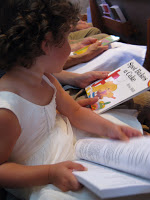
This morning my husband and I drove to Scarborough to attend the baptism of our niece and nephew; Paul had been asked to be the godfather of his sister's son. As a non-Catholic with no sense of the sequence of events at a mass, let alone knowledge of the responses, I spent most of the service keeping an eye on our active niece (though I did take a long moment to say a non-denominational prayer for my best friend's father, who's critically ill). Undaunted by the silence of dozens of people in the pews around her, she grabbed a hymnal and began "reading" from it aloud. Then she tossed the hymnal aside and began perusing "Spot Bakes a Cake" and a Sesame Street ABC book with the same intensity. For some reason this struck me as a wonderful juxtaposition--images of Grover and Big Bird alongside the reading of the day's homily and the singing of "America the Beautiful." And all being taken in by an angelic-looking two-year-old with wild curly dark hair wearing a long white fancy baptism dress. The only point in the service in which she got at all upset was when she was dunked into the baptismal font, but even that passed quickly.

After lunch and family time, my husband and I decided to stop at Scarborough Marsh for a little birding. The tide was high and the humid air clung to our skin. Throughout the marsh, willets--large sandpipers that breed there--flew back and forth, white wing patches flashing, crying, "Pe-will-willet, pe-will-willet!" Their noise seemed rather alarmist, as the marsh was otherwise placid: slack tide brimming at the edges, still air humming with insects, little other bird activity. I'm not sure how this connects at all to the morning's baptism, except that both experiences involved water, and I did briefly give thought to what it must feel like for a young willet to step into the water for the first time, committing itself to a life of marsh mud, tidal waters, and salt-fragrant air. I bet it cries out in alarm too, before acceptance.

Life-giving water
baptizes both bird and child--
high tide, blessed font.