Contact ME

Use the form on the right to contact me.


123 Street Avenue, City Town, 99999

(123) 555-6789

email@address.com


You can set your address, phone number, email and site description in the settings tab.
Link to read me page with more information.

IMG_1267.jpg

Book of Days

BOOK OF DAYS: A POET AND NATURALIST TRIES TO FIND POETRY IN EVERY DAY

Sign up on the Contact Me page

August 16: Hummingbirds

Kristen Lindquist

When my friend Diane calls me at an odd time at work, I know she's seen a cool bird in her yard. This afternoon was no exception. "I've got a rusty red hummingbird with a red throat here," she said. I was at her house in minutes.
Rufous Hummingbird, male; Rockport, Maine
And there he was, a male rufous hummingbird in all his shining red glory. He spent most of the hour I was there perched in a tree, where he stood out like an autumn leaf. He perched in full view with an eye on her hummingbird feeder. I only saw him approach it to feed once, when I took the above photo. But whenever a ruby-throated hummingbird, the native species you'd normally expect to see here, tried to feed, he would swoop down and chase it away. He was slightly bigger and puffier than the natives, which apparently made him somewhat of a bully.
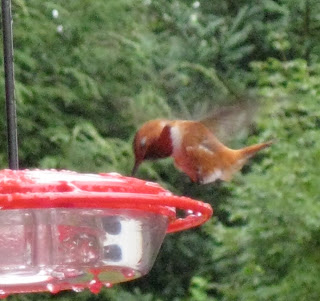
For reasons other than his obvious beauty, seeing this hummingbird is a big deal. Look in a bird book and you'll see that rufous hummingbirds live far west of the Mississippi. The only other ones I've seen have been in the Rocky Mountains. But occasionally one will go astray during migration and show up in New England. I've never heard of one being seen around here, though, and I've certainly never been so fortunate as to see one in Maine. 

While we were watching (and trying to photograph) the rufous hummingbird and the comings-and-goings of the resident ruby-throats, our attention was drawn to movement in a potted jasmine plant on Diane's porch. At first we thought it might be another hummingbird, but we quickly realized that it was an insect. A hummingbird moth, to be specific--a very cool moth that looks just like a hummingbird. I think I've only seen one or two of these before, so it was almost exciting a sighting as the  errant rufous hummingbird.
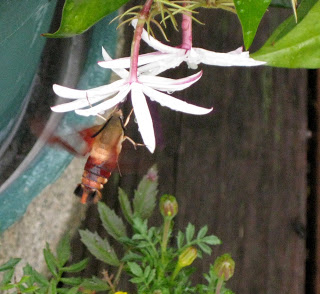
Hummingbird Moth
This afternoon's sightings reminded me--you should always keep your eyes open on what's buzzing around your back yard!

Hummingbird--so small
your body, so fierce your heart.
May you burn brightly. 
August 15: Perfume

Kristen Lindquist

These humid days when I'm puttering in the herb garden plucking and trimming, aromas of the bruised leaves hang heavy in the air. Imagine the licorice fragrance of fennel mixed with the tang of lemon thyme. Or the sharp pungency of chives blended with the soothing tones of lavender. Or parsley, sage, and mown grass. The palette of potential perfumes is endless and ephemeral. Like these fleeting weeks of summer when I can spend a morning in my garden with the sun hot on my hair, breathing the scented air deeply and with great joy.

No better perfume
than these crushed leaves of thyme, mint,
rubbed on my warm throat.

Speaking of herbs and summer, when I was in Portland on Friday a friend recommended the new Mount Desert Island Ice Cream shop on Exchange Street. "You've got to get the blueberry basil sorbet," he said. Intrigued, I passed up other unusual ice cream flavors like lavender, salt caramel, and Jack Daniels and got the sorbet. If ever a flavor embodied summer, that was it. Think a mouth full of juicy berries with the fresh, green after-taste of basil. No wonder this is where President Obama went for his infamous ice cream cone when he and his family vacationed on Mount Desert Island last month. (According to a sign posted in this new offshoot of that original Bar Harbor shop, he ordered coconut.)

August 14: The Call of the Sea

Kristen Lindquist

It's rather ironic that as I sit on my back porch about to write a post about waking up this morning to the sound of an osprey chirping overhead, I can hear the cheesy carnival-esque music of an ice cream truck making its slow pass through our neighborhood. There's something about ice cream trucks (and clowns, for that matter) that creeps me out, although I'm sure to children with more innocent minds the music is as saliva-inducing as Pavlov's bell was to his dog.

When I awoke on yet another perfect summer morning today and heard the osprey before I even got out of bed, I thought to myself that I don't think I could live where I wouldn't hear that, or at the very least, the sound of gulls. That reminded me of something in Tolkien's The Lord of the Rings books, when Legolas, a prince of the wood elves, is told that if he hears the gulls, he'll never return to his forest realm. I'm not sure if that was meant to be a straightforward prophecy--for he does hear gulls when he reaches the sea and ends up spending his life traveling Middle Earth with his dwarf companion--or if there was something more implied.

Personally, having grown up in midcoast Maine, I think there was more to it. I wouldn't want to live for any amount of time away from the ocean and the cries of the gulls and ospreys. I like to imagine that once Legolas saw the sea, its lure was inescapable, so that he could never be satisfied with life in Mirkwood Forest again. Of course, coming from a place called Mirkwood, it seems like the attractions of  the sea would be obvious--sunlight on waves, the expanse of the open water, sea birds twinkling overhead... I guess what I love best about this place that is my home is the perfect combination of waterfront and woods--I can wake to ospreys as well as to a cardinal's whistle and the rustle of wind in the leaves. I can hike for several hours on mountain trails shaded by big old trees and be rewarded at the top with an ocean view: the best of both worlds.

A few minutes ago, my husband (in a nearby lawn chair) told me that he could smell the sea. He too grew up near the ocean and understands how fortunate we are to be able to sit beneath an ash tree alongside the river, breathing in salt air--and also, how inevitable, as if we could bear to be anywhere else.

With an osprey's voice
the sea wakes us up, beckons,
its blue doors open.

August 13: Perseids

Kristen Lindquist

The Perseid meteor shower peaks today. This summer shower always carries a festive connotation for me, because it coincides with my friend Woody's birthday. Woody and I used to work at a writers conference in Vermont together every August, the dates of which always overlapped with his birthday. However we chose to celebrate (and being writers, we were creative--think pinatas, night swimming, tequila), the evening was never complete without a viewing of the meteor shower from some strategic point on the conference's rural campus. I don't think there's a better place to watch falling stars than one of the Bread Loaf hayfields surrounded by the profound dark of the Green Mountain National Forest. Our viewing was often punctuated by the howling of coyotes hunting in the river valley. Their wild yipping and the usually dramatic meteor show seemed the perfect birthday celebration. (As I said in my post two days ago, sometimes when it's your birthday, good things seem to revolve around you.)

After the Red Sox hit their fourth home run against Texas tonight (and their third in a row!), it seemed safe to leave the game for a few minutes to step out back and see if the sky was clear. It was, so I decided to stay out long enough to see one falling star. Perseus rises directly over our roof, so I had an unobstructed view. What I at first thought was a faint haze was, I realized when my eyes had adjusted, the Milky Way. My celestial observations were accompanied by an acoustic guitar sing-along on our neighbors' back porch tonight, creating an enjoyable if unusual atmosphere in which to watch the night sky. I was reminded a bit of those past summers at Bread Loaf.

I saw a falling star in less than five minutes and realize now that I should have made a wish on it for the Red Sox: Texas has since responded with three home runs of their own. Friday the 13th does not appear to be our star pitcher Josh Beckett's lucky day. But I'm happy nonetheless and look forward to going out to the back yard to rack up a few more wishes after the game.

Meteor shower:
Perseus tosses out stars,
each pitch a bright wish.

August 12: TVs on the Tower

Kristen Lindquist

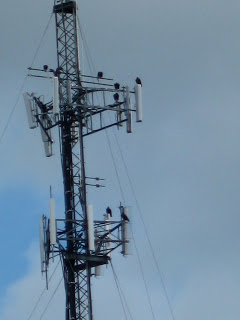
Yesterday on a hike up Ragged Mountain we emerged from the woods onto the rocky ledges of the ridge to the sight of four turkey vultures (known in birder parlance as TVs) soaring past at eye level. They then made such a close pass overhead that I wondered if they could smell the tuna sandwiches in our backpacks. Like us, they seemed to be enjoying the beautiful day, tilting and circling on the thermals--the hot air rising off the mountain--with what looked like acrobatic joy above the summit. TVs are skillful fliers, and to watch one at such close range makes one imagine leaping off the rocks, arms spread wide, to give it a try. It's worked for me in dreams, at least.

A radio/communications tower stands at attention rather incongruously on the otherwise rugged and wild heights of Ragged. I couldn't help but laugh when I observed one of the vultures soar close to the tower and then land on it. Of course its many crossbars makes an ideal perch, and at one point as we skirted the ridge line I counted eight vultures perched at various levels on the tower and more flying nearby. It looked like they were making the most of this human-made structure that had sprouted on their mountaintop. I guess vultures are opportunistic in more ways than just as carrion eaters. I admire their adaptability.

Mountaintop tower--
to us, ugly; to vultures,
a convenient perch.

August 11: Loon Birthday

Kristen Lindquist

When it's a special day, a birthday, it can sometimes seem like every good thing that happens is for your benefit. The universe revolves around you, celebrates your very existence. That's a good birthday.

Today is my mom's birthday, and while she was relaxing in a lawn chair out on her float on the river this morning, she got her gift: the two resident adult loons and their fuzzy brown chick approached within ten feet of her. My mom has been watching this baby loon's development since it was hatched, so it's virtually part of the family at this point. If she doesn't see it every day, she worries. The loons, of course, were wishing her a happy birthday. And the parents were teaching their youngster a lesson, catching a fish and dropping it in the water in front of the chick so it could learn how to catch fish for itself. The true gift was their letting my mother observe such intimate animal behavior up close.

Thankfully, the universe continues to revolve around Mom tonight, as the Red Sox, her favorite team (and mine), seem on their way to another victory versus Toronto.

A touching side note about my mother's birthday: when my sister told my four-year-old niece Fiona that today was Nanny's birthday, she burst into tears, upset that Nanny was "getting old and would die." My niece's universe revolves around my mother for sure!

Loon family visit--
river offers up this gift.
Happy birthday, Mom!

August 10: Dwellings (of sorts)

Kristen Lindquist

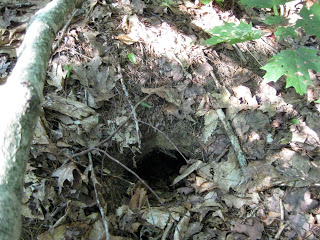
Who lives here? On a hike through the woods today on a conserved property in Lincolnville, I came across this den. Do groundhogs live in the woods? It's about the right size for them. A little discovery like this always gives me pause, makes me wish I were more woods-wise. And there's that part of me that wants to stick my arm in the hole and see what's in there...

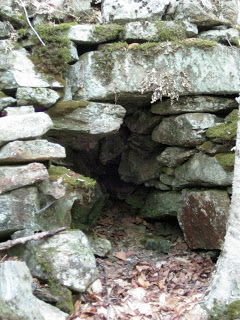
Deeper in the woods, near some of the largest trees I've ever seen in the Midcoast (ash, pine, aspen) and a striking patch of glowing white baneberry, we came across this interesting stone structure.
No one had a clue about what it might be. The opening doesn't go in more than three or four feet, so it doesn't look like a place where something would have lived, but perhaps the rocks at the back of the opening caved in at some point in the past.

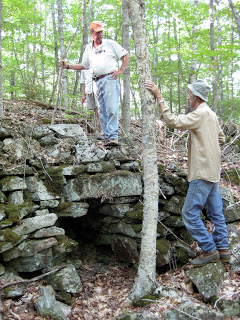
Here's a photo with people to give some perspective:
Property owner Rick Ledwith (top) and Orvil Young
Others on the outing suggested that it might be a lime kiln or even a burial mound of some sort. It made me think of purported sacred sites made out of stone that I remembering hearing about in Vermont: "megalithic mysteries." I was reminded of Skara Brae, a prehistoric stone village I visited in the Orkney Islands of Scotland when I was a kid. There's probably a more practical explanation for this interesting structure, such as its being a crude farming shed: these woods were lined with old stone walls indicating that the area had been pastureland around the end of the 1800s. But I prefer to imagine that inside that south-facing opening one might find runic carvings on the stones or perhaps discover that it aligns with the sun's rays on the Summer Solstice.

Or, really stretching my imagination--maybe it was a dwelling for wood elves. Maybe it still is. Such crazy thoughts added a little more mystery, a little more wild magic to these woods so close to a major road and several houses, bisected by a snowmobile trail and power lines. And that feeling was only enhanced by the haunting call of a loon on nearby Megunticook Lake.

Never really tamed,
these woods still harbor strange caves,
poisonous berries.

August 9: New Moon

Kristen Lindquist

No, I'm not referring to Stephenie Meyer's vampire book. Tonight the Current Moon Phase gadget on my Google home page tells me that the moon is 0% full: a new moon. Although I guess technically if the new moon is the thin slice of moon filling up again tomorrow night, tonight is really "no moon." The lack of moonlight would make this a wonderful evening to check out the stars if it weren't cloudy.

The new moon, when the moon is a big black zero in the sky, happens once a month when the moon is in direct conjunction with the sun, meaning that the earth, moon, and sun are aligned in such a way that we see no sunlight reflecting off the moon. We're reminded that the moon's phases are all a trick of light and mirrors, that the dry moon itself gives off no light of its own. Our faithful satellite floats invisibly in the dark void until the earth and sun shift enough for us to see that sliver of reflected light again. Day by day the area of light grows--the moon waxes--until the full moon. Then it wanes till there's no moonlight at all--the new moon again. A lovely cycle, setting up a perfect metaphor of the cycle of life, birth and death, beginnings and endings.

Perhaps this is why in so many religious calendars around the world--Muslim, Hindi, Buddhist, and Jewish--a new month begin on either the day of the "no moon" or that of the brand-new moon, when that first crescent shines along the moon's rim. The Muslim month Ramadan, a deeply spiritual time of fasting each day from sunrise to sunset, begins with this new moon, for example. For Hindus, the new moon is Amavasya, an auspicious day, a time to pay respects to one's ancestors and make offerings. A new moon on Monday, the moon's day, like today, is particularly significant and various Hindu rituals are performed depending on where one lives. There's something I find particularly intriguing about celebrating the dark, a time when the moon disappears and we have only the stars left to guide us.

No light of its own,
new moon is no moon, blank disk
awaiting the sun.

August 8: Morning on the Marsh

Kristen Lindquist

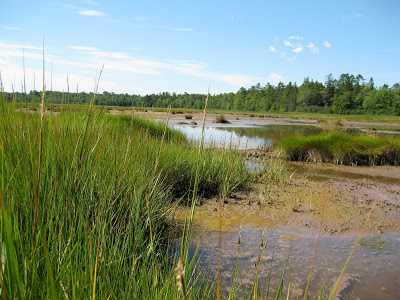
Starting in early August each summer I try to make regular visits to Weskeag Marsh, a significant salt marsh in South Thomaston, to observe the shorebirds on their migration. Believe it or not, this southward movement is already underway.

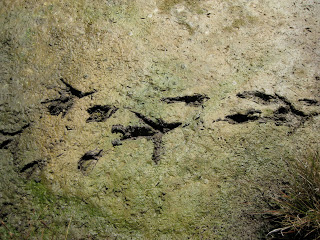
Weskeag is an experience for the senses. On this still, sultry morning, the salt pannes were low, with fragrant marsh mud exposed around the near-dry pools. Mosquitoes swarmed each time I paused, but not enough to distract me. Cicadas whined in the trees, and crickets chirped in the grass. The marsh is a dynamic place always, thanks to the cycles of tides and the movement of birds. Although relatively quiet today bird-wise, it never disappoints. In the pannes closest to the parking lot, several killdeer milled in the reeds, occasionally calling with strident voices. Further out, tiny fish called mummichugs churned in the deeper channels cut through the mud. I was thankful for my knee-high rubber boots after stepping off the path at one point and sinking into about six inches of the mucky black silt. Bird tracks were etched onto the drying surface of the pannes, ranging from what looked like turkey tracks to webbed duck tracks to the tracks of little sandpipers almost too light to make an impression.


In the wide pannes, yellowlegs moved through the shallow water, feeding. Their three-note "too too too" call never fails to stir my heart a little, as it evokes this special place so well. These larger sandpipers are absent from the marsh only a few months a year, as they pass through heading north to their Arctic breeding grounds in early spring through late June, and can be seen on their journey back south in late July through November.

Swarming around the feet of the yellowlegs were several dozen least sandpipers--adults on their return trip and young birds on their first migration. You can tell them apart because the adult's feathers are worn, making the bird look faded next to the "freshly minted copper penny" plumage of this summer's youngster. These tiny birds have a journey still ahead of them, which accounts for their near ceaseless feeding as they fatten up for the long haul. In the back of the marsh a few dozen shining white snowy egrets and a handful of  great blue herons stood amid the higher marsh grass. Every now and then one would rise up and fly to a new spot, reminding me that these beauties were tucked away back there.

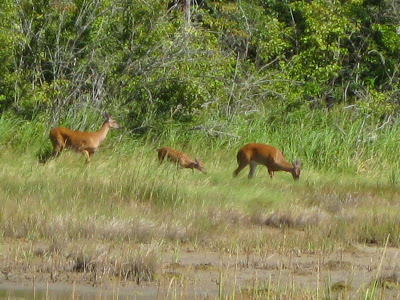
As I paused with my spotting scope to check out some sandpipers, I heard something crashing in the woods beyond. I looked up from the scope, and to my surprise three deer walked out into the marsh--two sleek does in their warm brown summer coats and one spotted fawn. I tried to be still as they picked their way along the edge of the marsh and looked up repeatedly. Even the fawn had already learned to be on heightened alert. One doe calmly turned and went back into the trees, but the other doe with fawn moved along until I lost sight of them in the tall cattails. Beautiful animals. May they remain wary and survive.

Just for being there
I was blessed with this: three deer,
unafraid, and birds.

August 7: Sleeping in the Car

Kristen Lindquist

My mother has told me that when I was a baby the only way they could get me to fall asleep sometimes was to put me in the car and drive me around for awhile. I guess old habits die hard, because if I'm in a moving vehicle for more than 45 minutes--and I'm not the one driving, of course--I very often fall asleep. Yesterday I fell asleep on the ferry back from Vinalhaven (and woke just outside the Rockland Breakwater to see the three-masted schooner Victory Chimes in full sail). This afternoon I fell asleep as Paul drove us home from Freeport. (I woke up to the much less picturesque Rt. 17 & 90 intersection.) I'm still a bit groggy, but better rested, thank you. There's just something so soothing about sitting back in the passenger seat as the miles roll by, knowing I'm in safe hands with my husband at the wheel, and closing my eyes...

Drowsy in the car.
Even fields of goldenrod
can't keep me awake.

August 6: Pelagic

Kristen Lindquist

Three birder friends and I had picked this day several months ago for a seabird trip from Vinalhaven with biologist John Drury in his boat Fluke. Who knew we'd have such luck? Today everything came together for the perfect pelagic outing: good people, clear skies, relatively calm seas, and lots of birds*.

There's something special about the birds you see when you're on the open ocean with no land in sight. Wilson's storm-petrels, small brown seabirds that dart among the waves like swallows, seemed to appear out of nowhere to flit past the boat and then disappear beyond the swells. Young gannets dropped from height, plummeting after fish head-first, straight down into the water like shining white arrows that always hit their target. Terns wheeled acrobatically on slender white wings, dipping into waves right alongside the boat for little fish to bring back to almost-fledged young. At one point we saw two jaegers in the distance and gave chase, but these big, gull-like birds that like to steal prey from other birds were quickly out of sight.

Sometimes we passed a lobster boat pulling traps, and each swell would half-hide the other boat from view. But these were long, smooth swells, no white-caps in sight, so not scary, just a little disorienting. It doesn't take long to get into the primal rhythm of the water, the rise and fall that every so often seems to come to life in the form of the dark fins of porpoises. A day like this makes me think owning a boat would be really cool, until I remind myself that days like this are truly rare.

Fog lifts. Swelling sea
carries us on its grey back.
We leave land behind.

* I would be remiss if I didn't somehow get in here that the real highlight of this pelagic trip was seeing a red-billed tropicbird on Seal Island, a life bird for me. This tropical vagrant is spending its sixth summer in Penobscot Bay, which it has apparently chosen as its home. John Drury, who knows the location of the bird's lair on the island, says he thinks it thinks it's a tern, but the terns don't want to have anything to do with it. This exotic summer visitor is, I fear, doomed to lead a lonely life, unless a fellow tropicbird of the opposite gender also happens to wander this far off course...

Tropicbird in Maine--
despite your lonely summers,
you keep coming back.