Contact ME

Use the form on the right to contact me.


123 Street Avenue, City Town, 99999

(123) 555-6789

email@address.com


You can set your address, phone number, email and site description in the settings tab.
Link to read me page with more information.

IMG_1267.jpg

Book of Days

BOOK OF DAYS: A POET AND NATURALIST TRIES TO FIND POETRY IN EVERY DAY

Sign up on the Contact Me page

August 5: Birding After Dark

Kristen Lindquist

As I carried our supper dishes to the sink tonight, I was surprised to notice a hummingbird visiting the bee balm outside the kitchen window. Dusk had fallen, and it seemed way past that bird's bedtime. Perhaps visiting our garden was like "last call," a final pit stop before roosting for the night. The bird had to be a neighborhood regular that had fed at these flowers before, because in the half-dark, it obviously wasn't the red of the petals that had attracted him.

Even later I was surprised to hear the distinct "pip" call note of the cardinal, making his evening rounds. As my husband pointed out, he's still showing up at around the same time at day's end, but it's getting darker earlier so it seems like he's here later. If that makes sense. In any case, when he made his last visit to the window feeder tonight, I could barely see him. If he weren't so loud, announcing his arrival with such advance fanfare from across the street, we'd never have noticed him on the shadowed feeder.

His voice precedes him.
Cardinal's last visit at dusk--
dark bird, red hot song.
August 4: Haze

Kristen Lindquist

A soft haze clung faintly to the landscape as I left work this humid evening, muting the edges of trees and lawns. The overgrown field of milkweed, goldenrod, Queen Anne's lace, fern, and timothy surrounding our office lightly perfumed the air with the scent of hay. Besides the background whirr of crickets, several goldfinches chirped merrily as they dipped over the tall grass. The moment was dream-like, made even more so by that dazed feeling one sometimes has at the end of a long day of work in a hot office: a high summer's afternoon dream.

Hazy, drowsy field.
I could curl up and sleep here
amid these soft ferns.

August 3: Blackberries and Poems

Kristen Lindquist

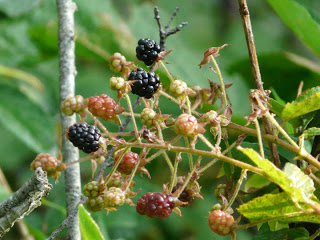
Hiking up Beech Hill in Rockport I noticed that the blackberries growing along the trail were red and ripening fast. I was reminded of one of my ongoing, slow-growing collections: blackberry poems. Over the years, I've accumulated my own personal anthology of poems that include blackberries as the subject or key image. The poets include Sylvia Plath, Robert Hass, Seamus Heaney, Elizabeth Barrett Browning, Yusef Komunyakaa, Mary Oliver and, inspired by aforementioned, myself. (I'll include a complete list below.)

There's something about blackberries that render them good subjects for poetry. Back in my grad school days, I probably would have tried to write an essay on the topic, describing how the staining black juice of the berries is irresistibly similar to ink, how the ephemeral ripeness of the fruit is the perfect metaphor for the fleeting joys of summer or life or a relationship. Or how plucking the delicious berries from amid the thorny bushes is the perfect metaphor for life or a relationship. You get the idea. Blackberries are quite literally food for (poetic) thought.

But these days, inspired by the discovery of a new blackberry poem or the sight of a real live blackberry patch, I simply re-read my collection, picking through the poems with pleasure, as if eating berries from a basket.
Photo by Brian Willson
Blackberries don't last.
But their purple ink lingers
in printed poems.


Blackberry Poem Anthology
Elizabeth Barrett Browning, section of "Aurora Leigh"
Robert Hass, "Meditation at Lagunitas"
Seamus Heaney, "Blackberry-Picking"
Jane Hirschfield, "August Day"
Elizabeth Hobbs, "Blackberry Picking"
Galway Kinnell, "Blackberry Eating"
Yusef Komunyakaa, "Blackberries"
Mary Oliver, "August" and "Blackberries"
Sylvia Plath, "Blackberrying"
Henry Taylor, "Blackberries," section from "Three Snapshots"
Jack Turner, "The Plan"
Allison Childs Wells, "In the Blackberry Patch"
Douglas Woodsum, "A Country Awakening," "Poem for Stephen," "Mental Health Diet," "Blackberry War," "Fourteener #301," "Fourteener #37," "Fourteener #28," and "The Black Way" (a poet friend who clearly shares my enthusiasm for the poetic potential of blackberries!)

August 2: Big Dipper

Kristen Lindquist

We got home late tonight after seeing a movie, and the clear, starry sky curved over our heads as we stood in the driveway unloading our stuff. There was the Big Dipper with its ladle full of night, poised upright above the house, reminding me that north is "up the street." Whenever I see the Big Dipper, by habit I follow the imaginary line made by the two stars on the right side of the cup up to Polaris, the North Star, my touchstone in the night sky in any season--all the other stars pivot around it as night and the seasons progress.

I paused a moment in the front lawn to take it in, all that celestial beauty, and the background humming of crickets seemed to be the music of the spheres, emanating from the heavens themselves.

August night, crickets--
stars dance around Polaris.
Supernal music.

August 1: Predators

Kristen Lindquist

Today is the pagan holiday of Lughnasa or Lammas, the first harvest holiday of the season. I celebrated this perfect summer day on the Elizabeth Ann, watching seabirds in Muscongus Bay under blue skies and on calm seas for Friends of Maine Seabird Islands' fourth annual seabird adventure. We cruised out to Eastern Egg Rock with about 120 people on board, most of whom hoped to see puffins. And puffins we saw, though not in great numbers. Puffin Project researchers on the island counted record 109 pairs this summer, but only a handful of the colorful little birds were hanging around offshore today. What we did see: black guillemots, laughing gulls galore (1,500 pairs of those on the island!) making a racket along with the clouds of terns (common, Arctic, and endangered roseate all nest on the island), cormorants, eiders, a big cluster of ruddy turnstones, a couple of Wilson's storm-petrels dancing on the waves, a few gannets in the distance, some "peep" sandpipers, several great black-backed and herring gulls, osprey, bald eagle, harbor seals, and harbor porpoises.

And a peregrine falcon, which strafed the island, flushing every bird into the air in a screeching, swirling mass. It stooped, the fastest bird on earth, and when it rose into the air again we could clearly see it held a tern in its talons. The falcon flew off trailing an angry mob of terns dogging it like silvery wasps, but it did not relinquish its prey. Early harvest.

The cruise began to feel like a Discovery Channel nature show when around the next bend we came upon a great black-backed gull attacking a young laughing gull headfirst. While we watched in awe, the gull killed this bird almost half its own size and dragged it off to tear apart for a meal. Another early harvest. As Sue Schubel from Maine Audubon reminded us over the boat's speakers, "It's not being mean, it's just eating dinner." I've never seen anything like it. But apparently the birds nearby had, as they barely even noticed the commotion just a few feet away.

As we circled the island several times we also were able to observe many guillemots catching rock eels the same vivid red-orange as their feet. Terns and puffins flew in to young with beaks full of fish. A riffle on the water chased by a gull revealed where a school of fish was driven to the surface by larger fish. And just before we turned away to head back to Port Clyde, a peregrine scared up the birds once more...

A lot of harvesting going on, the bounty of the sea made visible by this island teeming with healthy bird life. And a joyful day overall, which we celebrated by enjoying our own harvest from the sea at Cod's End in Tenants Harbor on the way home.

Not gull's prey this time,
cormorants look away, calm,
dreaming of herring.

July 31: Loon Call

Kristen Lindquist

Most mornings I hear a loon calling as it flies north over the house. The river out back is much too shallow and rocky here to accommodate a loon--they need a certain amount of open water to get up enough speed to take flight--so these early calls are from a loon in transit. Does the bird have a dawn fishing ritual in Camden Harbor? Wherever it goes each day, we're lucky enough to live in its flight path as it presumably returns to the lake.

It always gives me a little thrill to hear that tremolo as I go through my morning ablutions. Although we live in a dense neighborhood just a mile from downtown Camden, this flight song of the loon is our own call of the wild, hinting of remoter places. For just a few moments I look out at the craggy face of Mount Battie and imagine that I'm spending this golden summer at an old sporting camp in the North Woods wilderness, with a sunny deck overlooking a lake full of trout and loons that know how to properly greet the day.

Loon's dawn reveille.
Clean morning air promises
perfect summer day.

July 30: Loon Chick

Kristen Lindquist

This evening we spent time with my four-year-old niece, who is staying with my parents for the weekend. We had dinner al fresco in the back yard, and then Fiona and I decided to sit on the dock and watch the river. Water bugs skittered across the surface, and Fiona was excited to see a couple of small fish slip past us underwater. As my husband got his fly rod ready to do a little casting before sunset, we all noticed the loon family in the middle of the river: two adults with one fuzzy brown chick between them. They seemed to be teaching it how to fish. Fiona looked through binoculars at them, but I'm not sure she knows how to use them well enough to see the birds. My mother tried to explain to her how loon calls are different depending on where they are, that the place, not the bird, determines what they sound like. I think that too was beyond Fiona's interest and comprehension at this point, but we'll make a birder out of her yet!

Fish began jumping as sunset burnished the clouds. Fiona was impressed with Uncle Paul's dragonfly fly. She'd probably have been even more impressed if he'd caught something with it. Four ducks that I think were wood ducks flew past. A beaver slowly made its way upriver, as it does every evening, a silver vee trailing behind it. And the loons drifted upriver too, still fishing. My dad built a small fire in the fire pit, and we all stayed outside in the growing dark, past Fiona's bedtime.  

Loon chick with parents--
family night on the river.
I watch with my niece.

July 29: Restless

Kristen Lindquist

A restless breeze blows through the leaves this evening, washing away the remaining traces of today's heat and humidity. While the cooler air is refreshing, there's an edge to it that hints of fall, and I'm not ready for that yet. It's still July for two more days, and I want to continue to absorb as much summer sunlight and warmth as I can--a sort of solar recharge for the cooler months that I know are coming. So this wind makes me a little anxious and on edge, like being faced with an unwanted conflict. It cascades through the trees in a rising rush of sound, indistinguishable from the flowing river. On our after-dinner walk around the block, my hair whipped across my face and waving branches flung themselves in our path. The wind is just toying with us now, but already we can glimpse the faint gleam of its wintry teeth. This is the kind of night when I find myself awake at some odd, early hour unable to fall back asleep, just lying there trying to still my mind and block out the noise of the wind swirling through the yard, crashing against the house. Nights like this I can relate in some weird way to those pampered Victorian maidens who had a fear of "drafts."

As evening descends
wind rises like a flood tide
through shivering oaks.

July 28: Deer

Kristen Lindquist

I rode to work this morning with a co-worker, and as we pulled into the office parking lot, she exclaimed, "A deer!" A doe was dashing down the dam access road from our parking lot, tail flashing, though she was shielded in part by trees between us and the river. We could see enough of her to follow her progress until she went off the road and down an overgrown embankment. Then she disappeared. Even though we'd moved up to the office porch for a clearer view and would have seen her had she made her way into the woods on the other side of the office, she'd vanished completely. This was a large doe, too. She was probably right there in front of us, watching our every move with those predator-wary eyes. Amazing how a big wild animal like that can slip out of sight so quickly and without a sound.

I think this is the same doe that has visited the office in summers past, a couple of times with a very young, spotted fawn. I've taken photos of her standing right outside my office window. Another neighbor I'm always pleased to catch a glimpse of, however fleeting. It's partly that fleetness that's keeping her alive, after all.

Summer doe grazes
in ferny fields, in daylight,
yet always wary.

July 27: Crickets

Kristen Lindquist

My mother's nickname for me growing up was Cricket, so I think that just gave me a natural affinity for the insect, which I still enjoy observing in my yard. When I was a kid I made a little box out of toothpicks so I could keep a pet cricket like I had read that the Japanese do. I wasn't sure what to feed it, so I gave it little bits of bologna, which I'm pretty sure it didn't eat. I only kept it for a day and then freed the poor thing because it wouldn't make its cricket noises for me.

When they start "singing" loudly enough to really take notice, that's a sign that summer's reached its peak. This afternoon I was sitting at my desk, just sitting and thinking, and I suddenly really noticed the sound of crickets. There's supposed to be some formula you can use to figure out how warm it is from how rapid the cricket's chirps are, but all I know is that it's a hot afternoon and the individual chirps produced by the crickets' wings are coming fast, blending together to create a rising hum. We get used to hearing it in the background on days like this, but it really is a beautiful chorus of sorts when you take a moment to listen.

The hum of crickets
awakens me from daydreams.
Summer is passing.

July 26: Golden Glow

Kristen Lindquist

I confess, I love goldenrod. Just look at it! I love the golden glow it brings to the lush fields of high summer, that rich sunny color hinting of the maturity of the season. (And green and gold are such a vivid combination. No wonder so many sports teams use it, including my grad school alma mater, University of Oregon). 

I love how its appearance signals the arrival of my favorite time of year, late summer into fall, when above these burnished fields, birds will soon migrate south once more, the very air humming with their restless spirit. Goldenrod's height and hue make it seem as if Mother Nature put all her remaining flower power into firing up this late bloomer of the year. 

As with many flowers, goldenrod gets more intriguing the closer you look at its little starry florets. Its a complex plant, and there are actually dozens of species of goldenrod, guaranteeing hours of field study to figure them all out. 

Unfortunately for me, I'm quite allergic to goldenrod. I know they say that it's not really goldenrod people are allergic to, it's the ragweed that blooms at the same time. But no, I've been tested, I'm allergic to ragweed and goldenrod. Which is why today my voice is hoarse and I'm squinting at the screen because my contacts are a bit gummy. But none of that dims the joy I feel when I look out the window at those glowing golden sprays, offset perfectly by the reddening leaves of the dogwood and the Queen Anne's lace (see yesterday's post), with the river shining in the background.

Does anyone doubt
gold is the color of joy
in this rich season?