Contact ME

Use the form on the right to contact me.


123 Street Avenue, City Town, 99999

(123) 555-6789

email@address.com


You can set your address, phone number, email and site description in the settings tab.
Link to read me page with more information.

IMG_1267.jpg

Book of Days

BOOK OF DAYS: A POET AND NATURALIST TRIES TO FIND POETRY IN EVERY DAY

Sign up on the Contact Me page

August 23: Brief Revival

Kristen Lindquist

The purple clematis that climbs up my porch railing has had its best summer ever, flourishing like never before with both greenery and blooms. I attribute its health to a tip from landscaper Tom Jackson, who told me that it needed some shade around its base. I let ferns grow around it, and instead of all the leaves dying off halfway through the flowering cycle, as had happened past summers, they're still going strong here in late August. And although the flowers have come and gone--the pretty petals all fell off several weeks ago--we noticed yesterday that the recent rains seem to have encouraged a brief revival: one fresh blossom and another just-opening bud, looking bright and fresh amid the spiky remains of all those gone-by blossoms.

One last clematis!
I'd already said good-bye
until next summer.

August 22: Just some eagles

Kristen Lindquist


Late yesterday afternoon we visited my sister and family at their lakeside camp. My brother-in-law, father, and two nieces were out in the little beat-up motorboat that my brother-in-law had somehow coaxed back to life, making the most of the day's dying light with one last ride. When they landed at the dock, my five-year-old niece came running up to see us. "How was the boat ride?" we asked her. "What did you see out there?" "Oh, just some eagles," she replied nonchalantly.

Shortly thereafter, as we shared hors d'oeuvres on the deck, we did indeed see a bald eagle, soaring majestically over the island directly across from us. My niece informed us that she wasn't a fan of eagles because they "look mean." As best we can tell, her only frame of reference for an eagle's facial expression is the wooden eagle sculpture that was hanging near our table at The Waterfront Restaurant when we took her out to dinner there recently. For a child, however, the devil's in the details.

What I love is that seeing "some eagles" is almost a non-event for her. I don't think I saw my first bald eagle here in Maine until I was in high school. And it was years more before I began seeing them on a regular basis. Maine's eagle population has made an incredible comeback from the days of DDT--there are over 500 breeding pairs in the state now, and the species has been federally delisted. Eagles soaring over Maine's lakes are becoming a common sight, one that I hope will remain so for my nieces for many years to come.

A wish for my niece:
may bald eagles always soar
in your summer skies.

August 21: Fire Hydrant

Kristen Lindquist

Dense fog has settled over the midcoast, as often happens this time of year: 100% humidity. Even the crows' cawing in the yard sounds a bit muffled. A short run left me soaking wet (not to be too gross or anything), the moist, warm air clinging to my skin, mingling with my sweat. Mount Battie was completely hidden by the mist.

This time of year, I particularly enjoy how the goldenrod in the fields glows so brightly on these muted mornings. One family along my running route mows only the lawn directly in front of their house; the rest of the yard, between the strip of lawn and the road, they let grow wild. Chipping sparrows, doves, and goldfinches seemed to enjoy this, as well, as that's where they were all hanging out today. Right now, that roadside field is rife with blooming goldenrod, made all the more stunning by the fact that the backdrop, their house, is bright red with lime green trim.

But what struck my eye the most on my little outing was, oddly, coming upon a newly painted, vividly red fire hydrant tucked away in the roadside weeds. The town has been repainting all its fire hydrants this summer in an attempt to make them more visible, and that certainly worked with this one. I must have passed it a hundred times on my runs and never noticed it amid all the surrounding greenery. In its way it was on the same fog-busting color scale as the goldenrod. And in its way, on this quiet, muggy, foggy morning, just as beautiful.

It's not a cardinal,
but this hydrant's shade of red
also makes me smile.

August 20: Things Invisible to See

Kristen Lindquist

While I was reading in the back yard late this afternoon, a hummingbird was chattering perpetually overhead. It seemed to be buzzing between our yard and our neighbor's (which is full of enticing flowers right now), pausing occasionally in a spruce tree that hangs over the fence between us. I don't know if it was nesting in the spruce--I've found hummingbird nests in spruces before and admired the added protection of all those prickly needles--or perhaps sipping spruce sap, but the tree seemed to be its primary focus. Its high-pitched calls were not aggressive or territorial, though the bird can be both, but more conversational. A "here I am, hanging out near my favorite tree" kind of sound.

Meanwhile, I could also smell a delightful fragrance on the breeze, the scent of some unknown flower wafting my way. If I closed my eyes in my lawn chair, the redolent air combined with the birdsong around me (mostly the hummingbird), and I could almost imagine I was somewhere semi-tropical.

Shortly thereafter I learned that an old friend and his family had recently been in a very bad car accident. Apparently among his serious injuries, his heart was literally crushed. (He's a writer, and I know that when he recovers, he's going to use that image as a metaphor somehow.) This all seems like a non sequitur, but as my mind shifted from enjoyment of the hummingbird's song to coming inside to write about it and then learning about my friend's accident, this silly haiku project--my attempt at trying to pay attention to these little moments that make up our life, these fragments of beauty, joy, and poetry--seemed somehow more important than ever to me. We never know when they might all be taken away, or when we might be forced to shift our perspective on what even constitutes beauty and joy for us.

Rather than reducing them to trivialities, I think such mindful moments can help root us in the present and give value to our existence, and by extension, the existence of all life: hummingbirds, aromatic flowers, the fragile physical existence of humanity... One moment I was listening to a hummingbird and pretending I was in the Caribbean; the next, my thoughts were entirely with my friend and his family. And yet the two moments are united, just as when we think about where we were when we heard sad news, some unimportant detail always surfaces and becomes a part of that whole experience. (When you think of where you were when you heard about the planes hitting the World Trade Center, for example, what random details surface in your memory?)

As the world suffers,
in this moment I focus
on hearing a bird.


August 19: Drowsy

Kristen Lindquist

At Long Grain in Camden for lunch I enjoyed rice cakes with chives in some kind of sweet sauce and a rather filling bowl of crabmeat fried rice (topped with a "free range egg")--way more than I usually consume at that time of day. As soon as I got back to the office I felt in desperate need of a siesta. Instead, I plowed on through to finish up all that I'd wanted to get done this work week, but uncharacteristically left the office right at 5:00.

I was supposed to go for a run tonight, but wasn't really looking forward to it because I was still feeling so sleepy, a state not helped by this muggy weather. My own tired body conspired to save me from my run, however because as I was walking out to my car, I slipped on the gravel and fell hard, banging up my knee. No big deal, but sore enough that I didn't want to run on it right away and aggravate the swelling. Instead, I grabbed a magazine and an ice pack and lounged in the back yard for an hour. A hummingbird buzzed overhead, paused on branch. Maybe she was tired, too. A crow flapped desultorily past. Crickets chirred dreamily. I might have fallen asleep on the spot if my husband hadn't arrived home. There's something that seems so indulgent, so langourous, about letting yourself just give in to sleepiness when it's not "bedtime." Like letting your mind go on vacation.

Crickets' lullaby,
all birds silent in this heat:
let all thoughts go. Sleep.

August 18: Nighthawks

Kristen Lindquist

Yesterday someone posted a report on the Maine Birding listserv about seeing over 100 nighthawks migrating over the Kennebec River. One of the joys of late August birding is coming upon flocks of these acrobatic fliers soaring over a field or waterway as they wend their way south. They really do look a bit like small hawks, with their pointed, slender wings; and yes, they do prefer the evening hours, when they "hawk" for insects, darting and twisting with true aerial skill and beauty.

This evening I was attending an outdoor event being held in a big open hayfield. I mentioned to a birder friend there that this would be the perfect place to see nighthawks. They seem to prefer that time at the end of the day when the light is rich and clear, just before dusk begins to fully settle. And sure enough, about half an hour later we looked up to see several nighthawks flying overhead, flitting off to the next field and out of sight. Sometimes when you're in the right place at the right time, what you expect to see actually shows up.

Besides annual glimpses of nighthawks migrating--I think in particular of one August evening a few years ago when I was driving along the Penobscot River north of Orono--the most memorable nighthawk observation I ever experienced was when my husband and I were in Tucson, Arizona for our honeymoon. The resort where we were staying was surrounded by desert and backed by Mount Lemmon, a lovely place, and we'd found some interesting birds just walking the grounds. Walking past the tennis courts one night, which had their lights on for those who wanted to play in the coolness of evening, we were shocked to look up and realize that dozens of nighthawks were flashing through the night sky chasing all the insects drawn to the court lights. An unexpectedly breathtaking sight, like suddenly being visited by a host of angels. We just stood there and watched for a long time.

Dusk falls, angels come--
flitting above the river,
migrating nighthawks.

August 17: Grasshoppers

Kristen Lindquist

Last week's New Yorker featured an interesting article on humans eating insects for food (entomophagy). It included a photograph of a lipsticked mouth about to eat a giant, colorful grasshopper. While I enjoyed the article and could even imagine myself at some time eating sauteed termite larvae or chocolate-covered ants, there's no way I could ever eat a grasshopper. They've grossed me out ever since I got a science kit when I was 7 that included a big lubber grasshopper to dissect. My stepmother and I dissected the frog just fine, but I threw away the grasshopper. It scared me.

My disgust may be rooted in having read at an early age the Laura Ingalls Wilder book "On the Banks of Plum Creek," in which the Ingalls family's wheat crop is decimated by a plague of locusts--or rather, a swarm of grasshoppers. She describes in horrific detail the swarming mass of the insects, the constant sound of their chewing, and how they crawled over everything, even through their house.

Hiking with an entomologist friend many years later, however, I couldn't help but be amused by how he'd catch a grasshopper, observe it a closely, even a bit tenderly, while reciting its scientific name, and then let it go again. He'd say, "There's a fine bug!" in true admiration. To an entomologist, at least, there's something to love about a grasshopper.

This afternoon part of my running route took me down a sidewalk that bordered a vacant lot overgrown with weeds. The pavement itself had been heated by the sun all day, and apparently grasshoppers were drawn to its warm surface, because with each step, dozens of them sprayed into the air in all directions. The whole length of the sidewalk, until I got to a house with a mown lawn, was grasshopper city. As long as I didn't have to eat or dissect them, I didn't mind. It was actually kind of cool, probably the most dynamic moment of my rather sluggish outing.

With each running step,
explosion of grasshoppers
from the hot sidewalk.

August 16: Sky

Kristen Lindquist

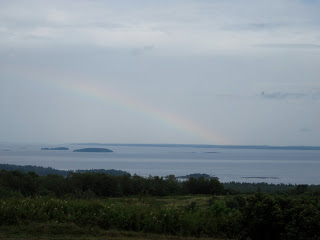
Coastal Mountains Land Trust's Annual Meeting took place this evening in Beech Nut, a stone, sod-roofed hut at our Beech Hill Preserve in Rockport. We were a bit uneasy at first, because it had been raining steadily all day, and to reach the hut you have to hike 3/4-mile up a dirt road, utterly exposed to the elements. But as we began setting things up, the rain abated and a rainbow spread over Penobscot Bay. We took that as an auspicious sign.

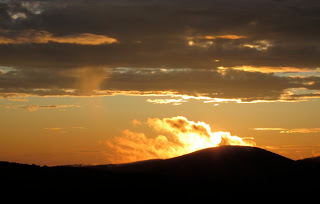
At the end of the meeting, as mist lifted from the mountains and the day's storm clouds passed away to the east, sunlight broke through to shine on the fields and islands below. And soon, we were treated to a breathtaking sunset--the kind that just gets more beautiful and intense the longer you watch. It began as an explosion of sun against Mount Pleasant, turning it into a virtual volcano, and ended as layers of pinks, purples, and peaches spread across spangled clouds and puffs of mist, a riot of color and texture. 

One of the special aspects of Beech Hill is its open summit, revealing the sky in all its glory. Tonight I felt grateful to be able to watch the sky shift through so many moods in such spectacular fashion as we celebrated the Land Trust's 25th anniversary.   

Thankful for these clouds
making rainbows possible
and-oh!-this sunset!


August 15: Only in Maine

Kristen Lindquist

I met an old friend from high school for a drink after work today. He's been living a life in high finance and investing in New York, so he doesn't get back to Maine often. When I showed up, he said, "I know I'm in Maine when it's cold and raining and you're wearing flip-flops!"

My friend had taken his two little boys mackerel fishing in Rockport harbor today in a punt with a tiny motor. They hadn't gotten far when the motor broke. But the boys had trolling rods, so he ended up rowing them around the harbor for an hour-and-a-half while they fished for mackerel. They each caught three. I've got to think that as they grow up in suburban New York, their Maine summer experiences will seem magical to them. Those are the lasting memories, the ones that will bind them to this place no matter where they end up.

Walking to my car in the rain, dusk falling, I watched an osprey soar overhead on its way to the harbor. I love that I live in a place where ospreys sail past on a regular basis, in any weather.

Back home, as my husband and I were planning out what to have for supper, a friend drove up with a tray full of fresh-caught squid: there's our meal. Perfect. Only in Maine. It's these little things, these telling little stories of place gathered up each day, that make me feel so grateful that we live where we do.

A friend shares his catch:
squid jigged in Rockport harbor.
Fruit of the full moon.

August 14: Flocks of Geese

Kristen Lindquist

This morning I passed a large gathering in a farm field along Simonton Road. The field hadn't been hayed for a while, so the geese were surrounded by tall grass, with frilly white blooms of Queen Anne's lace bobbing above their heads. I'm sure there were a lot more geese in that field than I could readily see as I drove on past. It was almost comical, all those long necks poking up through the greenery and wildflowers. Migrating flocks pausing in the short-grass prairies of the Great Plains must have once looked like that. (I say "once" because there are so few pockets of this habitat left, though thanks to land conservation efforts there are some remaining bits of these once vast, wildlife-rich prairies.)


A little further along, on Meadow Street at this point, I passed another, smaller flock of geese. This group was grazing on what would best be described as a large lawn of cropped, green grass. The geese were quite visible and well occupied with poking around for whatever it is geese poke around for in fields... I know domestic geese like to pull up plants and can actually nicely weed a garden bed. Were these geese simply plucking grass or was there something juicier they were after?


OK, I had to look that up. According to the Cornell Lab of Ornithology, "Canada Geese eat grain from fields, graze on grass, and dabble in shallow water by tipping forward and extending their necks underwater. During much of the year they associate in large flocks, and many of these birds may be related to one another." So these flocks I was seeing were probably extended family groups chewing on the scenery. But when I saw them, especially the first, larger flock that made me laugh, I wasn't actually thinking about their feeding habits or their communal behaviors (e.g. it's a well-known fact that geese generally pair for life). I was thinking, "Geese are on the move already? [Expletive deleted.] Summer's almost over?!"


Geese flocking in fields.
I'm never ready for change, 
but Earth keeps turning. 

August 13: Early Morning Clamor

Kristen Lindquist

My niece Fiona slept-over last night--in my bed with me, in fact, while my poor husband (who snores) was relegated to the inflatable spare bed in his office. Because we stayed up so late watching a movie she'd brought, she fortunately fell asleep almost immediately, after my reading only two pages of "Little House in the Big Woods." This morning, we both woke up at 6:00 a.m., but thankfully she decided that was too early to get up and so fell back asleep.

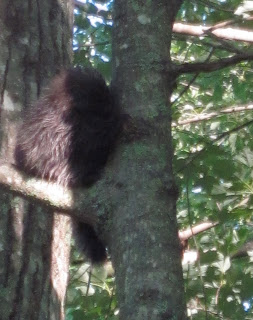
I was almost asleep again myself, when it started: the blue jay racket. Right outside the bedroom window, several jays were yelling loudly and incessantly at something and they were not relenting. I kept thinking that any minute they'd stop, having moved along an intruding cat (usually what instigates such a racket) or hawk. But they kept going, and I worried they'd wake up my niece. Being a good auntie (who wants more sleep herself), I went outside to see what it was and if I could help move it along so the birds would shut up. I was very surprised, when I got out there, to look up and see a young porcupine hanging out in a tree just above our shed. I wasn't going to have much influence with that situation. So I went back in to bed hoping Fiona would somehow sleep through the noise now augmented by a family of cardinals and a couple of crows. Of course she didn't.

But she was very interested in going out to see the baby porcupine. So we watched it for a while, and then began our day. When my husband woke up an hour later it was still there. Two hours later it was still there, only having shifted position a bit. But when we returned from a day's outing with my niece and her family late this afternoon, it appeared to have moved on--from our yard, at least. Since porcupines are slow creatures, it's probably not far away. (My niece astutely compared it to a sloth.)

I'm still not entirely sure why the birds were so agitated about the porcupine, which was probably just looking for a place to hang out and nap for the day (they're generally nocturnal). My husband thinks it would eat birds' eggs if it found them, but I think they're mostly herbivores. Perhaps the birds just don't like a bulky mammal hanging out in their trees.

Real life angry birds
disturbing the porcupine's
sleep and mine--for what?