Contact ME

Use the form on the right to contact me.


123 Street Avenue, City Town, 99999

(123) 555-6789

email@address.com


You can set your address, phone number, email and site description in the settings tab.
Link to read me page with more information.

IMG_1267.jpg

Book of Days

BOOK OF DAYS: A POET AND NATURALIST TRIES TO FIND POETRY IN EVERY DAY

Sign up on the Contact Me page

July 7: Old mill

Kristen Lindquist

My husband and I have a new writing room: a rented office/studio space in the renovated Knox Woolen Mill building in the heart of downtown Camden. Our windows are directly over one of the dams that used to be part of the millworks. In fact, the controls to the dam itself are located in a corner of our studio, with a little sign indicating how long it takes to raise or lower the dam. Since we've gotten a lot of rain, the river is still running high. The drop over the dam is substantial, creating a vigorously churning waterfall that will serve us effectively as a white noise machine when we're hard at work.

The big windows of our third floor studio frame an interesting view. On the other side of the river sits the part of the old mill that was converted to condominiums, several of which boast nice decks. A mature oak tree grows up through a hole cut into one deck, its leafy branches blocking a view of Mount Battie which we will undoubtedly enjoy come winter. If you lean out the window, the mill's smokestack rises high into blue sky above the mill buildings and the fast-moving river. On the mill pond of calm water behind the dam, a family of geese hangs out amid the reeds. And on Saturday mornings and Wednesday afternoons, the Camden Farmers' Market is visible through the trees in the mill parking lot.

When I was five, we lived for a while with my great-grandmother in her apartment across the street from the mill. It was still very much a working mill then, and I remember hearing the daily whistles for lunchtimes and shift changes, as well as the machinery clacking away day and night. I had to walk past the mill to get to kindergarten, and I always hurried over the dark, turbulent river as it flowed beneath the mill and under the street on its way to the harbor. Thanks to my great-grandmother's vivid warnings, I could imagine all too well what would happen to me if I fell in. Now my studio overlooks that very stretch of river. Hopefully it will once again spark my imagination.

White water: white noise.
I lose my thoughts in the falls,
river of childhood.
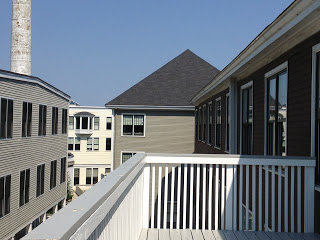
View of the old mill buildings from a neighboring office


July 6: Fireflies

Kristen Lindquist

Because of the fog, Fourth of July fireworks were postponed until last night here in Camden. It being my niece's birthday, we spent the evening with my family at the lake instead.

While cruising around the lake in my brother-in-law's boat--outpacing some dragonflies and otherwise making the most of sunset's golden glow at the end of a long, hot day--we came upon a boat full of guys setting off their own fireworks. Nothing fancy, just colored lights fired into the air with a satisfying "bang," but enough to entertain my nieces, ages three and six. Now that purchase of fireworks is legal in Maine, I have a feeling we'll be seeing more these modest "neighborhood" displays on various holidays. Setting off fireworks over a lake seemed the perfect way to enjoy them, and it certainly lit up our twilight boat ride, adding that extra burst of fun to make a little girl's sixth birthday even more special.

As we were heading for home down the long dirt road from the camp, the woods showcased the best fireworks show of the summer: fireflies! A dark grove of spruce trees was particularly illuminated by dozens of blinking, flashing creatures, inspiring one to make wishes as if on falling stars come to earth. As kids my best friend and I used to catch a jar full and bring them into the tent with us whenever we were "camping out" in the back yard. I remember how mystified I was each morning when the magical living lights of the night before turned out to be rather plain-looking black insects.

Driving back into Camden, we passed the fireworks traffic heading out of town. We had missed the big fireworks show over the harbor. But we were graced with some spectacular glimpses of the rising moon, a lopsided orange balloon slowly rising above the hayfields, that made me shout out loud in the car.

Fireflies, orange moon
rising over the harbor--
summer's brief pleasures.

July 5: Found poem

Kristen Lindquist

Like Proust's madeleine, sometimes unexpected, extremely prosaic things will trigger a flood of poetic thoughts and reveries. Today I was validating our CCR registration, a mind-numbingly bureaucratic process on the computer. (Don't ask me what CCR stands for; our government loves acronyms! It has something to do with making sure the land trust I work for is properly registered in the right system to receive government grants.) Where's the poetry in that? The last step of registering myself as a user for our account was to set up a series of five security questions, questions such as...

What was your childhood nickname?
What is the name of your favorite childhood friend?
What street did you live on in third grade?
What was the name of your first stuffed animal?
What was the last name of your third grade teacher?
What is the street number of the house you grew up in?
What was your high school mascot?
On what street did your best friend in high school live?
As a child, what did you want to be when you grew up?
What is your favorite fruit?
What is your favorite fragrance?
What time of day were you born?

When I came back to the present from my little trip down memory lane, I found myself wondering if the office worker tasked with making up these questions enjoyed coming up with them as much as I did trying to answer (all of) them (in my head).

Even government
red tape can have the power
to inspire poems.  

(And here's something perhaps even more prosaic: I wrote this blog entry while downloading Adobe Dreamweaver CS6 onto my computer. Who says we can't fit poetry into our mundane and busy lives?)

July 3: Knee high by the 4th of July

Kristen Lindquist

"Knee high by the 4th of July" refers to the height one's corn should be by now, if I'm remembering right. For me, it referred to the height of the grass in my backyard before I finally mowed it this evening. Each summer I seem to go longer before mowing, enjoying the various phases of flowers--first the little violets and forget-me-nots, later the daisies and hawkweed. At this point, the flowers had been subsumed by ferns and tall, feathery grasses, and I decided I wanted a cleaner look. Also, I wanted to be able to sit in my backyard without succumbing to an asthma attack from breathing all that grass-dust.

It felt a bit like mowing a hay field, except no bird's nests or baby rabbits were harmed in the process--though I half expected some creature to startle up in front of the mower. I did mow a blue jay feather, which felt wrong somehow, but disturbed nothing else larger than a moth. Still, the neighborhood flicker is calling over and over now, as if in alarm.

Good old sweaty work--
lawn so high it's like haying.
I should have a scythe.


July 2: Rumblings

Kristen Lindquist

Sometimes it's challenging to determine what's internal and what's external, leading to the mind-bending conclusion that my digestive system and the sky full of towering gray storm clouds are both parts of some grand, rumbling whole...

Summer afternoon--
is that my stomach growling
or rolling thunder?

July 1: Summer night

Kristen Lindquist

This morning, still in pajamas, I water the hanging plants, letting the dewy grass wet my bare feet. The neighborhood is quiet except for one robin singing from the coolness of the trees...

There was more action out there last night after twilight crept in and the heavy burden of hot, humid air lifted slightly: pack of kids playing volleyball in the neighbors' back yard grew louder as it grew darker and harder to see the ball. Streetlights came on. Cats came out to prowl the sidewalks and yards. Our cat, staying cool in the kitchen window, was fascinated by cats howling at each other in the street in front of our house. We joined her at the window, watching as the two cats made unearthly noises, circled each other, and then seemed to reach a standoff--after which, one cat rolled submissively in the gravel, the other stalked off to huddle under my car. Above the lawn, a firefly blinked on and off like a warning beacon.

But now another unusually hot day is underway. The buds of the day lilies swell. A squirrel performs its morning ablutions on the fence post in full view of a window where the cat often sits. She can't be bothered to come see. In the shadowy living room, she's scratching at a patch of sun on the floor as if it were a living thing, as if to draw it closer.

Is it love or war?
Two cats made loud by heat, dark,
face off in the street.


June 30: Youngsters

Kristen Lindquist

The other day a very motley-looking titmouse alit on my feeder. Instead of the smooth, plain gray that most titmice sport, this bird was patchy, with brown streaking on its belly and odd feathers sticking out here and there. It took me a few seconds to realize this was a fledgling, recently out of the nest. Already it has learned what a bird feeder is and how to make good use of it. Young-looking chickadees have been appearing at my feeder, as well.

This morning a catbird fledgling was perched on a post at the end of the driveway, whining to another bird waiting in a nearby tree. While the size of a mature bird, it too was a bit ragged around the edges, its sleek adult plumage not yet fully grown in. I've been hearing a catbird singing fragments of song outside my window the past week or so, and now wonder if that bird was a youngster--this one or a nest-mate--practicing its new singing voice.

Meanwhile, at river's edge, a young crow caws with an insistent, whiny pitch that any parent around the world would recognize as begging. On the river, a flotilla of geese, a few smaller and less distinctly patterned than the rest, heads upstream in a tight bunch.

And earlier this week, my two nieces, age three and six, returned to Maine with my sister and brother-in-law to spend the summer at their camp on a nearby lake.

Encouraged by warmth,
young birds try out new feathers,
children learn to swim

June 29: Scolding

Kristen Lindquist

My co-worker has been occasionally bringing her dog Chester to work. This afternoon Chester was tied up outside the office door, where he spent most of his time lying on the porch facing a big bush. A few minutes ago, I heard a loud, repeated chip note from this bush, an unusual sound for this part of the yard. On closer scrutiny, I spied the noisemaker, a male Common Yellowthroat. This tiny bird, smaller than the palm of my hand, was perched on a high branch of the bush and looking right at Chester, scolding the dog with a repeated "alarm" chip. He carried on like that for over five minutes, his fervor diminishing over time, until eventually he gave up trying to warn Chester away from the bush and flew off.

This wasn't a territorial thing, because the bird doesn't live in that bush, which is so close to my office window that I would have heard him singing loudly and often. At least one yellowthroat lives in the shrubs along the edge of the lawn, however. My guess is that the bird noticed the dog and chose to bravely fly up to confront it, or at least to make enough noise that others in the area would be alerted to the dog's presence. 

Chester didn't budge during any of this. I'm not sure he even registered that an assertive little warbler was making a lot of noise right over his head, let alone that he himself was the cause. 

Even I can tell 
the bird's sounding an alarm,
chipping, "Watch out! Dog!"  

June 28: First Monarch

Kristen Lindquist

In a calm between storms, we observed the first Monarch butterfly of the season flitting around the milkweed patch we let grow wild in the office yard. Monarchs depend on milkweed for much of their life cycle. They lay their eggs on the plants, their caterpillars feed almost entirely on milkweed leaves, and their butterflies sip nectar (though not exclusively) from milkweed flowers. 

Because milkweed contains toxic cardenolides in its sap, this diet renders both the caterpillar and the adult insect poisonous. A bird that eats one will throw up. I've seen a merlin catch a Monarch and then immediately spit it out in mid-air, so the bug must have a bitter taste. It's believed that the distinctive orange and black coloring of the adult Monarch, as well as the jaunty black-and-yellow stripes of the caterpillar, are meant to indicate that this creature shouldn't be messed with--along the same lines as the vivid colors of the poison arrow frogs of the Amazon.

The colors also make the Monarch easily recognizable to those of us who might be quickly scanning a yard to see what's blooming and buzzing. We noted a lack of Monarchs at this time last year, when they'd have been laying eggs, and in early fall, when they migrate. The milkweed stands ready. Hopefully it will host a healthy flock (what is a group of butterflies called?) this summer.

Oozing with toxins,
the milkweed awaits visits
from bright butterflies.


June 27: Purple finch

Kristen Lindquist

I'm wearing an elaborate purple finch barrette in my hair today, an accessory that I bought over 20 years ago when I was still in college in Vermont, dressing in tie-dyes and Guatemalan prints like a hippie wannabe. The barrette suited the person I was then, though it's a little much for everyday wear now that I'm older and, sadly, more conservative in my tastes. But as I was putting up my hair this morning, I remembered it was stashed in the bottom of my closet. Yesterday a female purple finch visited my feeders at the office for the first time--usually I get the more urban house finches--so I decided to wear my funky work-of-art barrette in homage of her special visit. 

My creative hair piece seems to have worked some sort of magic of attraction--this morning the male purple finch showed up at my feeder in all his glory. Unlike the plainer, brown-striped female, the male is bright raspberry, as if he were held by his brown tail and dipped headfirst into the berry's pink juice. Very striking and colorful, just like my barrette:
This barrette is probably bigger than an actual purple finch. And yes, the photo's crooked, but do you know how hard it is to photograph the back of your own head?
If my barrette can
summon finches, what shall I
wear in my hair next?

June 26: The heavens opened

Kristen Lindquist

I know I've been mentioning the weather a lot lately, but, well, this is Maine, and we really focus on the weather here--in part, because so many of us like to be outside, in part because the natural landscape and what's happening in it are important to us.

Also, it's sometimes unavoidable. A minute ago it suddenly started raining so loudly and so hard that it sounded like thunder drumming on the roof. A curtain of water gushes off the eaves, and a poor goldfinch perches in the feeder looking out, trying to decide if he wants to fly through that deluge or not. So far, not. Now, real thunder adds to the clamor. Meanwhile, the calm drone of voices continues in the conference room. Even when the heavens open, dumping buckets of rain, life goes on.

Parts of Penobscot County had flood warnings this morning, according to the emergency weather alert that came over public radio this morning. Seems like several mornings' classical music programs have been interrupted by weather alerts lately, thanks to a series of storms moving through. Ah, summer in Maine...

The world's a green room
with water as its ceiling,
water for its floor.