Contact ME

Use the form on the right to contact me.


123 Street Avenue, City Town, 99999

(123) 555-6789

email@address.com


You can set your address, phone number, email and site description in the settings tab.
Link to read me page with more information.

IMG_1267.jpg

Book of Days

BOOK OF DAYS: A POET AND NATURALIST TRIES TO FIND POETRY IN EVERY DAY

Sign up on the Contact Me page

Filtering by Tag: feather

August 24: The Little Things

Kristen Lindquist

>My naturalist friend Kirk is particularly fond of mushrooms, slime molds, and things in-between. His Vinalhaven Sightings Reportwhich features wildlife of all kinds seen on that Penobscot Bay island, is heavy on the fungus among us. His interest (and interesting photos) has made me take a closer look at the mushrooms around me when I walk in the woods--especially in late summer when the birds are quieter so I'm not looking up all the time.

Today while hiking off-trail on Ragged Mountain I was paying more attention to the ground in front of me just to see where I was going. I was surprised by how many mushrooms dotted the forest floor, especially a tiny, bright orange mushroom that looks like something you'd see in the garden of a gnome house. It's so cute that I've photographed it on several different occasions, including today. I thought to share my photo with Kirk, who quickly responded: "The cute little orange guys are so cute that they are the cover species on George Barron's 'Mushrooms of Northeast north America' book. They are Chanterelle Waxy Caps, which are in no way chanterelles at all. They are an adorable find, and as you already know, have a solid presence in the woods this time of year. One of my favorites to find." Now that I know what they are, I'll probably photograph them more than ever.
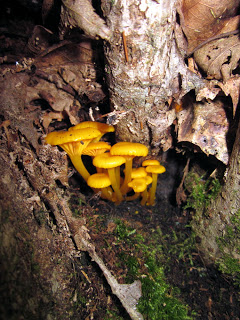
Chanterelle Waxy Caps
I noticed other intriguing mushrooms, including a pretty lavender one that Kirk says is from the Cortinarus genus, some turkey tails (the fungus, not the bird parts), some ruffly orange ones that might have actually been chanterelles, and a big puffy white one being eaten by a slug. The "Corts," says Kirk, have a mycorrhizal relationship with trees, which is complex enough that I'm just going to send you to Wikipedia to read about it, but basically means that the mushroom and tree mutually benefit one another.Not only did I have fun spotting all these various fungi, but I learned something too.

Besides mushrooms, I also discovered other little things: quite a few Indian pipes poking up through the leaf litter here and there, bunchberry berries, a teeny yellow flower that I haven't been able to ID (some kind of dwarf aster?), spectacular patches of reindeer lichen, deer scat, a couple of turkey tail feathers (bird parts this time, not the fungus), wide, spongy beds of sphagnum moss, and, in one place, scattered clusters of black and white feathers pointing to the demise of what was once probably a black-and-white warbler.


Trees, yes, and forest,
but also, tiny mushrooms,
berries, slugs, feathers.


July 8: Blue Jay Feather

Kristen Lindquist

Wandering through my back yard this afternoon, I came upon a blue jay feather in the grass, bright blue with black barring, a pretty thing. A family of blue jays lives nearby--I often see one perched on a particular branch over the back yard, and even more often, hear them. To find one of their feathers, so neat and intact, seems like a gift. Perhaps it was given in exchange for the ripe cherry tomatoes I've been lining up for the jays on a stump under their favorite tree.

The blue of a blue jay's feather is not a result of pigment, as with many colored feathers. Rather, it's caused by the way light refracts through the barbs of the feather. If you flip over a jay feather or hold it up to the light, it looks dark grey. So the blue, which so defines this brash, beautiful bird, is in a sense a mirage.

Blue sky, blue feather--
a gift given or molted?
Flight path souvenir.

July 19: Wild Kingdom

Kristen Lindquist

I bet if you polled a group of nature lovers / conservation professionals about my age or older, you'd find that the majority of them watched "Mutual of Omaha's Wild Kingdom" as a kid. Marlin Perkins and his trusty sidekick Jim were always tracking down wily wild animals on the savannah of Africa, shooting them with tranquilizer guns, and in the process, somehow doing something beneficial for science and nature. My grandmother semi-jokingly referred to it as the "torture torture show." I was simply happy to see cool wild animals up close on the screen.

The thing about watching nature shows like that is that you get the impression wild animals are lurking around every corner, just waiting to be chased and tranquilized, or at least observed through binoculars. When you get out into the woods on your own, however, you realize that most days seeing a red squirrel or the hind end of a deer might be about as exciting as it gets.

Today my director and I were walking a property with some donors--one of those situations when you want a place to be at its best. While we weren't so lucky as to have a bull moose walk through the field or a bald eagle soar past, Mother Nature didn't completely let us down. A red-tailed hawk circled overhead, then called dramatically. At our feet, we found two ruddy turkey feathers. Further along the trail, we came across turkey tracks in what was once mud, and then, the crescents of deer prints. And to crown the moment, a hermit thrush's lilting song rose from the trees. Nothing extraordinary, but the value of the place as wildlife habitat was validated. The donors were delighted; the animals had done their jobs well, even though the hawk was the only one we actually saw.

Deer tracks in the mud
and two feathers, patterned fans
telling wild stories.