Contact ME

Use the form on the right to contact me.


123 Street Avenue, City Town, 99999

(123) 555-6789

email@address.com


You can set your address, phone number, email and site description in the settings tab.
Link to read me page with more information.

IMG_1267.jpg

Book of Days

BOOK OF DAYS: A POET AND NATURALIST TRIES TO FIND POETRY IN EVERY DAY

Sign up on the Contact Me page

October 8: Wild Geese

Kristen Lindquist

This morning while at the YMCA gym I happened to glance out the window just as seven geese flew past. (In my memory now I hear them honking, but I couldn't have, because I was listening to my iPod.) They were flying in a tight line northeastward, over the town transfer station's landfill which abuts the Y. It struck me that even a brief glimpse of a few geese heading out over the dump is still a stirring sight, but I'm not sure why that is. It's not like seeing a Canada goose around here is unusual: a family nested and hung out within sight of my office all summer, and local farm fields currently host flocks of dozens.

In part, I think we earth-bound humans often feel uplifted watching a large bird take flight, something we can only do in dreams or with mechanical assistance. Years ago I dreamed I was riding on the back of a large grey goose as we flew over mountains carpeted in fall colors, and I've never forgotten how that felt. Also, as autumn progresses, the sight of a bird we all identify with migration must swirl something restless within our own souls: flying geese = winter's onset. Even those of us who love winter must respond, must feel a small, unconscious tug to follow the birds and warmth, to head south. Humans originated as creatures of the heat and sun, after all.

So the honking of geese overhead in the dark in the fall is for most a sound of deep poignance. As a classical Japanese kigo or season word, migrating birds, or wataridori is a traditional indicator of fall. I know I'm far from alone in being moved to poetry by this phenomenon--one might even say it's a bit of a cliche--and yet that handful of geese flying over the dump, not even migrating yet, are what struck a chord in my heart this morning.

Seven wild geese flew
and my heart longed to follow
through the deep blue sky.

October 7: Ducktrap Harbor

Kristen Lindquist

One of my favorite local spots is a small town park at the tip of Howe Point, which ends at the mouth of the Ducktrap River in Lincolnville. When I was a kid, I'd come with my family to this cobble beach to pick mussels, look for crabs under the rocks, and swim in the deep waters of the river channel, jumping in and letting the tide pull me into the ocean. This was also a high school hangout, where we congregated on weekend nights, shivering as we stood around in the dark sipping cans of Bud. And it's still a place I like to come with a beach chair and a book on a free summer morning. Or this time of year, to enjoy the quiet and my memories while observing migrating waterfowl.

This morning I had the place all to myself: high tide, sun dazzling the beach, harbor dotted with ducks. I counted 54 red-breasted mergansers scattered on the harbor, as well as two green-winged teals very close to shore on the river side of the point. The green speculum on the teals' wings flashed a brilliant emerald in the morning light. A ring-billed gull squealed from the shore, as a young double-crested cormorant repeatedly dove in the river channel, bringing up small fish. A crow flew into the tree over my head, silent; two more flew low over the stones further up the beach, looking for something, anything.


View to the harbor, with Islesboro a dark line on the horizon
Sun-dazzled harbor--
ten minutes here watching ducks
sets the whole day's tone.

October 6: First Frost

Kristen Lindquist

When I went out to my car for an early morning meeting, running late as usual, I was delayed even further by the unexpected task of having to scrape frost off my car windows. The lush, mown lawns in my neighborhood bore a pale sheen of frost, and the morning air felt frigid to my thin skin. Thankfully, I'd brought my geranium in the night before. Friends are scrambling to harvest one last round of vegetables, as another freeze is due tonight. And still the leaves remain on the trees, green, barely touched by color. They must know something we don't. I'm ready to haul out my Uggs and call it winter, but then I hear rumors that this weekend it's supposed to get back up into the 70s. Ah, the joys of living in Maine amid its vagaries of weather.

Before sunrise, frost--
but not yet on the pumpkin
freshly picked, uncarved.

October 5: Leaf

Kristen Lindquist

A moment of beauty amid the mundane: I've just parked my car in downtown Camden, and I'm scooting around to the passenger side door so I can get out my registration and insurance card to register my car at the town office across the street. As I open the door, I notice a single, perfect, bright yellow leaf on the sidewalk,  a composite of five leaflets on one twig. The parent tree, an ash, immediately recognizable by its straight, grooved trunk, shades the village green. It's probably been there for a century or so. The leaf I find is the only yellow one visible, the only one fallen--the rest of the foliage in sight is still green and on the boughs. So I pick up the leaf offering and stash it on the front seat. Later, when I'm done with my errands and back in the car, the sight of it makes me smile.

Why this leaf fallen
when the park is still so green?
Hint of things to come...

In light of this moment and then the news tonight of the death of Steve Jobs, 56, founder of Apple, I got to thinking about mortality. A dear friend unexpectedly passed away a couple of weeks ago (he was barely older than Steve Jobs), and this quotation attributed to Steve Jobs that was going around Facebook tonight spoke to me like that single ash leaf:
‎"No one wants to die. Even people who want to go to heaven don't want to die to get there. And yet death is the destination we all share. No one has ever escaped it. And that is as it should be, because Death is very likely the single best invention of Life. It is Life's change agent. It clears out the old to make way for the new. Right now the new is you, but someday not too long from now, you will gradually become the old and be cleared away. Sorry to be so dramatic, but it is quite true. Your time is limited, so don't waste it living someone else's life. Don't be trapped by dogma — which is living with the results of other people's thinking. Don't let the noise of others' opinions drown out your own inner voice. And most important, have the courage to follow your heart and intuition. They somehow already know what you truly want to become. Everything else is secondary. Remembering that you are going to die is the best way I know to avoid the trap of thinking you have something to lose." - Steve Jobs in 2005 after being diagnosed with cancer

October 4: First Tree

Kristen Lindquist

There's a maple tree outside my office window that's always the first to turn in fall. Today it caught my eye, the reddening leaves glistening in the rain. It's the only tree in sight that's changed color to that extent, and the vivid red is so flamboyant that it's as if the tree is showing off. Maybe that's why it's always first, because it wants to be sure to be noticed before all the other trees join suit.

Even one red tree
turns the whole forest to fall.
Who can look away?

October 3: Texture

Kristen Lindquist

When I left work this evening the blue sky above the rim of trees was ribbed with clouds. I was reminded of fashion magazines touting texture for fall styles: tweeds, bulky knit sweaters, wide wale corduroy, suede, and faux fur. Here we've got poufy clouds contrasting with the thin rippling lines of those ribs. The sky trying on its fall fashions, with just a flash of blue. No reds, oranges, or yellows yet.


When I left the gym later this evening, most of the sky had cleared, but Mount Battie wore a cap of thick mist.

Sky's a ribbed sweater
and mountain wears a cloud cap--
visual comfort.

October 2: Return

Kristen Lindquist

After nearly two weeks away on an island I'm back home, slowly acclimatizing to "regular life" again. The dreary rain suits my mood.

I sleep in late, rise
to the sound of rain, not waves,
my head full of mist.

October 1: Trap Day

Kristen Lindquist

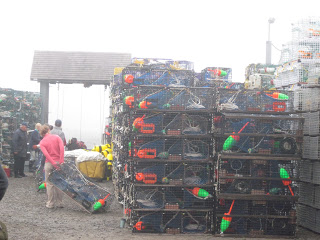
The lobstering season on Monhegan Island, where I've been hanging out for nearly two weeks, begins October 1. Monhegan lobster fishermen, of which there are nine boat captains (including two women), traditionally fish through the winter in hopes of getting a better price for their lobsters. (It also leaves their summers free to pursue other fish or other jobs.) So Saturday morning the boats all started out from the harbor laden with traps, undaunted by a pre-dawn thunderstorm and thick mist. Even from my inn I could hear the cheering from the wharf as the boats chugged out into the fog to set their 300 traps in precise locations on the ocean's floor.

It's hard to watch them go and not try to imagine what that must be like in January, hauling traps out of 45-degree water with freezing spray blowing across your bow. It's a life of hard work but a certain freedom--the ocean is your office. Or, at least the bit of ocean that surrounds the island in which the Monhegan lobster fishermen have exclusive fishing rights.
The wharf on Trap Day
Leaving the island on Trap Day is a bit daunting, as the "ferry" boats pull up to the same wharf as the fishing boats. A fishing boat can only hold so many traps at a time, so the remaining traps sit on the wharf until the boat returns to re-load. So boats are re-loading most of the morning, with the ferry having to grab a few minutes between them to get passengers and luggage on board. Passengers are funneled on board through walls of traps, while the wharf and harbor bustle around them--the true way of island life revived for another season.

Everyone chips in:
drag a trap, play some music.
This is island life.


September 19: Caterpillar

Kristen Lindquist

First thing in the morning I like to look out the front window to see the sun rising up over the edge of Mount Battie, to greet the day and get a sense of what the day's weather is. This morning, the mountain was draped with clouds seemingly in the process of dissipating. Out the back window, a crisp, clear blue sky hints of another beautiful day, a perfect day for getting on a boat and heading out to Monhegan.

When I looked out the window, I noticed a woolly bear caterpillar inching across our front walk. Another creature on a journey today. It was going at a pretty good clip. I paused to watch it for a while, then went into the kitchen. A few minutes later, when I looked again, it was gone, lost somewhere in the forest of grass.

It's that time of year when woolly bears roam around eating and looking for a good place to spend the winter. I've been noticing quite a few of them recently. They'll tuck into a piece of bark or curl up under some leaves and overwinter. Similar to hibernating frogs, woolly bears produce a substance in their bodies similar to antifreeze, which helps keep them from freezing solid in the winter. Come spring, the caterpillar will spin a cocoon and later emerge as an Isabella tiger moth.

As a kid, I remember being told that woolly bear caterpillars can predict how harsh the coming winter will be. The caterpillar has black bands at either end with a rusty brown band in the middle. The more black, the worse the winter, if I remember it right. While this has been pretty much debunked by science, one thing's for sure: when you start seeing woolly bears wandering around looking for a place to hole up,  winter is right around the corner.

Not yet equinox,
but I shiver. Woolly bears
seek out winter homes.

September 18: Wrapping it up

Kristen Lindquist

Tomorrow I leave for a two weeks vacation on Monhegan Island. When I return, it will be October. So this weekend I've been trying to wrap up all that stuff I need to do before I leave, which includes all my end-of-summer chores around the house and yard. The only thing written down on my to-do list was to pack, but here it is, early Sunday afternoon, and I've been bustling around all weekend taking care of things in a very satisfying fashion. Now, the house is vacuumed, plants watered, bird feeders filled, essential groceries my husband might need replaced, lawn mowed, gardens weeded (sort of), leaves raked, bushes pruned and mulched, gravel spread, work email set up with the "on vacation" reply, and laundry and dishes done.

But before I undertake the final, massive task of packing for two weeks on an island where the weather could range from just short of snow to sub-tropical, I'm taking a mindful moment on my freshly repaired and painted back porch to soak up this beautiful afternoon. I'm stepping into vacation mode just a few hours early.

The river is low right now so the water is just a quiet hush in the background, but a pileated woodpecker has been loudly calling for a while now and a pair of crows is yelling back and forth. Upriver, through the green wall of surrounding trees, I can see one red tree that's turned early. A small flock of waxwings flies over, which always brings a smile to my face. I love waxwings. A squirrel explores the edge of the lawn, while a chipmunk chips repeatedly just below, causing the squirrel to climb a tree, wave its tail like a furious little flag, and chatter back. In the distance, a lawn mower buzzes, white noise. My eyes keep closing involuntarily. Is there any calm felt so deeply as that derived from having accomplished what one set out to do, so that one can now simply rest?

How many moments
can we really say we feel
completely at peace?

PS: I may or may not post while I'm away for the next two weeks; my inn has sporadic wi fi, and I will be, after all, on vacation, focused on hanging out with friends and looking for birds... and maintaining this relaxed feeling!

September 17: Wrong place?

Kristen Lindquist

Birders up and down the coast today--from the Cadillac Mountain hawk watch to Freeport Wild Bird Store--reported seeing thousands of broad-winged hawks migrating through today. Yes, thousands. As in, they needed a little hand clicker to count all the birds they were seeing fly over. There were so many raptors in the air today, pushed along by a perfect NW wind, that their flight was visible on weather radar.

Meanwhile, my birder friend Ron and I, ignorant of all this hawk action overhead, decided to go look for shorebirds at Weskeag Marsh. We saw 12 sandpipers (that's individuals, not species) and about 20 snowy egrets. That many snowy egrets is a pleasant spectacle. But it's not 1,600 broad-winged hawks, etc.! What did we see for raptors? Immediately after we got out of the car we spotted a sharp-shinned hawk circling above us. A couple of minutes after that, an adult peregrine falcon flew off its perch along the marsh's edge and soared right past us, northward. (It was either hunting or misguided.) I always love to see one of them. We also saw two vultures circling high overhead, and in the distance, a buteo that was probably a red-tailed hawk. And that's it.

I admit that I'd love to have had the experience of seeing a zillion hawks. I've attended several hawk watches and they're exciting events, even without that many birds sailing through. But Weskeag was a beautiful place to be today. The marsh grasses are starting to fade and redden, the tide was still rising up the river, angelic white egrets fluttered in the back pannes, and the blue sky was bedecked with a scattered array of clouds that looked almost unreal, like a theatrical backdrop for a particularly cheerful scene in an old-style musical. The perfect backdrop for the amazing drama that is migration. What I regret about the day is not missing all those hawks, but the fact that I didn't have my camera with me to photograph that sky.

Those hawks, too, must have
gloried in today's blue sky
beckoning them south.