Contact ME

Use the form on the right to contact me.


123 Street Avenue, City Town, 99999

(123) 555-6789

email@address.com


You can set your address, phone number, email and site description in the settings tab.
Link to read me page with more information.

IMG_1267.jpg

Book of Days

BOOK OF DAYS: A POET AND NATURALIST TRIES TO FIND POETRY IN EVERY DAY

Sign up on the Contact Me page

December 6: Crow in Snow

Kristen Lindquist

One of my favorite short poems, by Robert Frost:

Dust of Snow

The way a crow
Shook down on me
The dust of snow
from a hemlock tree

Has given my heart
A change of mood
And saved some part
Of a day I had rued.

This morning I raised the bedroom blind to a shining white world, sun on snow, every tree coated with a thin layer of the fluffy stuff. I paused to admire the first snowfall of the season and the sparkling river running through it. Then I noticed some movement on our neighbor's lower lawn: a crow sat in the snow. As I watched, it dipped its body into the snow and flapped its wings. Was it trying to eat something under the snow? Was it bathing? We got about 3-4 inches of snow last night, so the snow came up to the crow's belly. It barreled through the snow a short way and dipped itself in again. A little further along, it repeated this action, wings akimbo. I called my husband in to see, and he agreed that the crow seemed to be either snow-bathing or simply playing. Ravens have been observed sliding down snow banks, an activity for which there can be no practical value, so why not a crow that's delighting in the first snow?

After a few minutes the crow flew up into a tree, shaking off the snow on the branch where it landed. The action reminded me, of course, of the Frost poem above. And in doing so, made me realize that this crow had gotten me through the hardest part of my day--getting up in the morning--with a smile on my face.

Crow bathing in snow--
you too feel the simple joy
of winter's first touch.

As I type this, a crow has several times flapped around one spot on a tree branch, then flown off. The branches obscure a clear view. I have no idea what it's doing. Through the binoculars, all I can see now is a nuthatch winding down the trunk. Who knows what goes through the minds of these creatures with whom we share our world? ... And now, a crow (the same one?) has just flown upriver carrying something large and white in its bill.
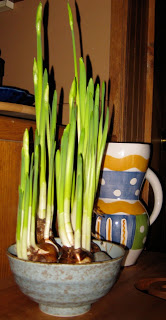
December 5: Paper Whites

Kristen Lindquist

A couple of weeks ago I bought a small paper bag full of paper white narcissus bulbs. That evening I put them in a bowl of rocks, added water, and set them on a table in the kitchen. Day by day the greenery has grown a little bit taller; some days I feel like they fit in growth spurts between one visit to the kitchen and the next. Now the tallest plant is a foot high, and they're all starting to swell with buds. They're almost flowers! From a tiny, dry, brown bulb to budding plant in two weeks--it seems miraculous.

Outside the sky is a chilly white, preparing for tonight's first snow storm (or so they predict). The squirrels have been active today, industriously chewing away at the Halloween pumpkin I put out by the mulch pile last week. At one point I saw just a little grey butt and fluffy tail sticking out from the half-eaten orange shell. Now, while two others chase each other over its head, that squirrel is grabbing chunks of the soft pumpkin rind and perching on a tree stump to eat them, stocking up in the face of colder weather and snow. From 68 degrees on Wednesday, with pelicans showing up in Spruce Head, to snow expected tonight. Another miracle of sorts. Nature is just full of herself.

Budding narcissus,
soon your perfect white flowers
will shine like new snow.

December 4: Pelicans

Kristen Lindquist

This morning Holly Anderson, editor of The Republican Journal sent me a set of bird photographs taken at 7:30 a.m. by Glenn Wiley from the shore in Spruce Head. (She has also posted some of them on-line at villagesoup.com.) Imagine my surprise when I realized I was looking at pictures of a group of eight American white pelicans! Apparently they left by high tide and haven't been seen since, which is remarkable given that these are probably the largest white birds to ever soar into Maine waters (they have a wingspan of 9 feet). They've only been reported in Maine about a dozen times before, usually one-shot glimpses of single birds, though back in 1874, another group of seven was observed on the St. Croix River.

Undoubtedly these birds blew in behind yesterday's dramatic storm. Am. white pelicans breed in midwestern and northern inland waters--I've seen them in Grand Tetons National Park and in central Idaho--and winter in extreme southern United States. Those warm wet winds yesterday probably carried them into what must have been terra incognita. Here's one of Glenn's photos, also shown at the villagesoup.com link above:


Notice the distinctive yellow bills and striking black wingtips. But this setting is definitely not your typical pelican habitat! I hope they enjoyed the novelty of their little foray into Maine waters. This is probably one stray species that isn't in danger of freezing to death up here, but I'm betting that they're heading back south now at a fast clip on those big wings.

Eight white pelicans
blown in by yesterday's storm--
a Maine vacation!

Update (12.7.09): The pelicans were seen by alert birders over the weekend off Rhode Island and then Connecticut, heading south where they belong.

December 3: Owls

Kristen Lindquist

This morning I spoke with a friend who lives on outer Rockport Harbor, surrounded by Beauchamp Point. She told me that night before last she woke up at about 4 a.m. to the sound of a ship's foghorn. She realized the weather must have turned in the night, and had just decided to try to go back to sleep instead of reading a book when she heard an owl call. The owl sounded like it was right outside her house. Then, she heard two other owls calling from distinctly different locations on her property. She realized that every time the ship's foghorn blew, the three owls responded from their various posts. She wondered if the owls thought they were hearing "the mother ship of owls" in some kind of distress--ship foghorns can sound so low and mournful. I love the image of an owl "mother ship" broadcasting to her followers as she moves up the bay, and the Beauchamp Point owls dutifully responding to her call, perhaps with some concern over her well-being. 

I posted this story to the Maine birding list-serv, asking if anyone else had ever heard an owl respond to an inanimate object (other than a playback device). A fellow birder then posted this very interesting story in response: "This spring (April 16) my husband and I were going to camp and I asked him to pull over at an area where I thought I might hear Woodcock along Rt. 17 near the Roxbury/Byron town line.  This was around dark, about 8:30 p.m.  We saw a moose kneeling and eating in the small field, close to the road.   As we were watching and listening, a dog from a nearby house started barking.  In response a Barred Owl started calling, which in turn got responses from a second Barred Owl, both not far away.  Not an inanimate object, but still very interesting.  (The next night we saw at least 16 moose along Rt.17 from Byron to Oquossoc, including one lying in the middle of the road, licking salt off the road!)"

Barred Owl, Photo by Hal Korber/PGC
So that made me wonder if perhaps the three owls--great horned owls from her description of their hoots--were trying to warn off the ship, thinking it was some giant owl invading their territory. We can only imagine what was going through the dark, feather-and-talon-lined corridors of the owls' minds.


Foghorn in the bay,
three owls respond to the call:
mournful hour of dawn.  

December 2: Night Clouds

Kristen Lindquist

Leaving a night meeting, I couldn't help but notice the sky spread over the parking lot and adjacent field. The full moon shone through cirrus clouds that rippled across the expanse of the deep blue heavens exactly like rows of foamy waves. The sky had become the ocean, with the moon a frosty blur behind the clouds as if underwater. The backlit striations radiated like static, white aurora borealis or northern lights; movement was almost perceptible. I felt I could almost reach up and feel the texture of the sky's oversized corrugations, and kept looking up at the sky through my windshield as I drove home.

Cirrus clouds. Full moon
shines beneath rippling waves,
draws the eye deeper.

December 1: Full Moon

Kristen Lindquist

It goes without saying that it feels like the middle of the night when I leave my office these days. Tonight as I drove home in the dark, my vision further obscured by the fact that I was peering through a sheen of frost slowly melting on the inside of my windshield, the full moon appeared from behind the mountain. I can see it from my living-room window now, above the hulking shape of the mountain and my neighbors' colorful Christmas lights, that bright face looking in at me and the cat in my lap.

The ancient Japanese aristocracy, with their highly developed aesthetic sensibilities, often held moon-viewing parties that involved poetry. According to Ivan Morris's book The World of the Shining Prince: Court Life in Ancient Japan (a companion guide to The Tale of Genji, a Japanese novel written over 1,000 years ago, my favorite book of all time, and the reason why I fell in love with haiku in the first place), the full moon of the Eighth Month was considered the most beautiful. The Great Moon-Viewing was celebrated thus: "To the sound of lute and zither music, men and women spend the night in boats on the artificial lakes of the Palace and of private residences, viewing the full moon and composing poems in its honor." It also "became customary to make offerings of dumplings and potatoes to the moon." Moon-viewing was clearly a warm weather activity. I won't be heading out in a boat on this cold evening to admire the moon, though I'm sure it's reflecting beautifully right now on Penobscot Bay. But perhaps we can cook up those fingerling potatoes I bought last week and celebrate in that way. And with a poem, of course.


The moon has inspired much Japanese poetry over the centuries and is a common subject of haiku. Chiyo-ni, the 18th century woman haiku master, wrote this after she became a Buddhist nun:

full moon--
keeping it in my eyes
on a distant walk

For her, observing the full moon was a form of meditation, a focus that brought her awareness. I have often found myself caught by the full moon, staring rapt like a deer in headlights. And as a child, as many children do, would fixate on the moon through the back seat window as it seemed to follow the car's every turn.

Chiyo-ni also wrote the following poem about the transformative powers of moonlight, perhaps as a commentary on women who spent too much time figuring out what to wear to a moon-viewing party. After all, the moon is the real object of attention, not them. But things apparently never change.

in the moonlight
whatever you wear becomes beautiful
moonviewing

(Translated by Patricia Donegan and Yoshie Ishibashi)

And thus I draw my inspiration for tonight's poem--my muses both Chiyo-ni, a woman who watched this same moon 300 years ago, and the full moon itself.

Full-faced moon, not shy,
wearing the mountain as robe,
beaming on us all.

November 30: Buffleheads

Kristen Lindquist

Temperatures in the mid-40s on the last day of November as we step through the doorway into December. Rain here on the coast, while a friend in Vermont reports snowflakes. The mailman says tomorrow is supposed to be colder, which would be more appropriate for December. It's kind of hard to muster up the holiday spirit when green plants still flourish in my herb garden, and another day of drizzle clouds the horizon.

Five months from now, I'm probably going to be complaining that it's April and snowing. What do I expect? I live in Maine, in a weird little coastal area that seems to have its own weather patterns, in a time of global climate change.

Out on the river the buffleheads bob. These small black and white ducks breed in Canada, into the Arctic, and spend their winters in the relatively mild climate of Maine's coastal waters. Days like this must seem nearly tropical to them. When they first appear on the river each fall, it's one of those big reminders that we're headed into darker, colder times. But despite this association, I find the ducks themselves fun to watch. Agile divers, they slip underwater in a blink. It's a challenge to tally how many you're seeing in a little group, because several at a time dive down and then pop up in unexpected places. This mild spell means the river will remain unfrozen a little longer, so the ducks will hang out here later into the season than usual. When the river freezes, most of them head for the harbors and inland waters of the bay.

Downcast by rainfall,
yet buoyed by bobbing ducks.
November's last day.

Photo from Wikipedia, the free encyclopedia

November 29: Jet Trails

Kristen Lindquist

Sun and blue sky after days of rain brought us out today. Paul and I hiked up Beech Hill with our friend Brian, marveling at the rare views of the bay visible through bare branches, recalling where we usually see songbirds in spring and summer. Damp leaves padded the muddy trail. Stone walls wind in all directions through the woods, marking long-gone pastures. And of course, the sod-roofed stone hut at the top of the hill takes one back to a different era, as well. 


Not much bird life to be seen. We heard some chickadees--those ubiquitous birds--and watched a single crow soar over the fields. Most activity was of the human sort, as others were equally happy to be outside in the unusually mild late November sunshine. As I was walking, I wondered what would inspire my poem today: the clear view revealing Mount Desert Island, Monhegan, and the three new wind turbines twirling on Vinalhaven? feeling the sun on my face? old maple trees locking down their sap for the winter? a dead birch pockmarked with square-edged woodpecker excavations?


Or what about the ephemeral but oh-so-sweet pleasure of devouring an entire pecan sticky bun at the Home Kitchen Cafe? Or buying a Christmas wreath, beginning our holiday decorating? Haiku capture fleeting moments or moods in just a few words. Any of those would do.


But as we drove home, I noticed out the car window an intersection of five jet trails at some point above Camden Harbor. The trails radiated outward through the sky like the arms of a giant vaporous starfish. I couldn't resist.

Vapor trails converge:
starfish in a sea blue sky
waves above the waves.


November 28: Rain

Kristen Lindquist

In our little house the sound of water is a constant. The river outside pours past, swollen now with the rain that has fallen heavily the past few days. Last night as I tried to sink into sleep, the rain drummed so loudly on the roof that I couldn't help but wonder if some large, agile animal were doing a dance in our attic. Knowing such a dance was impossible in our attic space full of blown insulation was small comfort for my insomniac anxiety. I could hear the rush of river, roar of wind, rain pattering on the propane tanks outside the bedroom window, and instead of feeling cozy and warm in my bed, I felt threatened within our home's thin walls.

I wondered if we would hear the emergency whistle above the noise of the storm if the Seabright Dam just upriver were to break. We live on a bluff above the still-visible flood plain of the river's former flow. But my childhood nightmares of giant waves washing away the house resurrected when we moved down river of two dams. As I lie in the dark listening to rain, my mind often wanders upriver to the body of Lake Megunticook--all that water just waiting there in the basin between Bald Mountain and Mount Megunticook--a barely restrained animal that, if it really exerted its full power, could go anywhere it wanted, fill every crevice of this town.

But those are night thoughts. This morning the white of the sky echoes the color of the wet shed and the foam churned up by the river as it rolls over rocks that are usually exposed. Chickadees and titmice slip from branch to bare branch like falling leaves. The lawn is an intricate brown tapestry of leaves. Moss on the north side of the shed roof is vivid green, flourishing in this moisture and unseasonable warmth. Slim bodies of trees sway in the wind. The rain seems to have stopped for now. I contemplate venturing outside for one last November run, but lean toward the lights and warmth of the gym.

Upriver the lake
lies silent, power contained.
But here--churn and foam.

November 27: Driving

Kristen Lindquist

Driving alone in the dark can play tricks with the mind. For some reason, listening to my favorite music turned up really loud in such an atmosphere always makes it more poignant to me. This poem isn't meant to capture a moment of angst, but a moment of intensity. That kind of moment we've all had when the lyrics speak directly to us, and it seems like the whole dreary, dark, wet world outside the car is a vast loneliness waiting to engulf us as we drive onward into anywhere. (Or perhaps I'm just speaking for myself. Really, not angst, but a strange and joyful level of emotional connection for me.)

Tires on dark wet streets,
car stereo turned up loud--
music of longing.

Tonight's playlist, for those who want to try this at home:

"I Wish I Was the Moon"--Neko Case
"Sometime Around Midnight"--The Airborne Toxic Event
"Free Man in Paris"--Joni Mitchell
"Read My Mind"--The Killers
"Fake Empire"--The National
"Before It Breaks"--Brandi Carlile
"Use Somebody"--Kings of Leon
"Search Your Heart"--Pete Yorn and Scarlett Johansson

November 26: Thanksgiving

Kristen Lindquist

Thanksgiving! And so the holiday season officially begins. My husband and I spent a good day in southern Maine enjoying a bountiful meal with his family, grateful for sharing time and food with those we love. We returned home in rain, dark, and fog, and I was worried the heavy mist would obscure my favorite part of this special day--seeing the star on the Mount Battie tower lit up for the first night of the season. I didn't think we'd see it through the clouds, but my husband bet me a quarter we would. Sure enough, when we crested the hill past Simonton Corner, there it was: a blur of light seemingly floating in the night sky. We might not even have been aware of what we were seeing if we didn't know there was a small mountain ahead of us bearing a star of lights on its summit.


Rainy Thanksgiving.
First glimpse of Mount Battie star--
smear of misty light.


And then there are other local holiday traditions that make me smile. As we turned into our neighborhood, we could see how our neighbors the Wards had spent their Thanksgiving. When we hit the road this morning, a deflated turkey lay slumped on their lawn. Tonight, thousands of Christmas lights, reindeer, candy canes, inflatable Santas and snowmen bedeck their home and yard. During the holidays, this is the most-visited house in town. Even when I was a kid we would make a special side trip so we could marvel at their light show. Only a Scrooge would complain about the energy drained. Not to sound like a credit card ad, but traditions like these that invoke the joy and wonder of the holidays--a joy and wonder that have persisted since childhood--are priceless. The nights grow longer these last few weeks until the Solstice. But our spirit is strengthened by these lights, this star, in the darkness.