Contact ME

Use the form on the right to contact me.


123 Street Avenue, City Town, 99999

(123) 555-6789

email@address.com


You can set your address, phone number, email and site description in the settings tab.
Link to read me page with more information.

IMG_1267.jpg

Book of Days

BOOK OF DAYS: A POET AND NATURALIST TRIES TO FIND POETRY IN EVERY DAY

Sign up on the Contact Me page

January 19: Ski Tracks

Kristen Lindquist

All day it has snowed--constant, slow, heavy flakes drifting ceaselessly down from the dim sky. All day I watched it fall, safe in my office. My only venture outside, once I got to work this morning, was to sweep the snow off my bird feeder and refill it, an act which produced immediate gratification in the form of some chatty titmice stopping by for a snack. Snow piled up on my car. The path to the parking lot softly filled with wet flakes. Meetings were cancelled. The mail was late. The world outside seemed muffled, buried as it was under this heavy white blanket.

When I left work, snow shone in the lights of the parking lot and in my headlights. Falling, falling, falling,  and it's going to keep falling through tomorrow, according to the weather report. Luckily the pile of powder in my driveway was light enough to just plow through with my car. Safely parked, I headed to the front porch for the snow shovel. No footprints were visible on the sidewalk, but two parallel lines ran past the house and down the street. Ski tracks. I could even see faint circles where the skier had planted his or her poles. The thought of someone blithely skiing through the neighborhood as I was working away right up the street somehow lightened my attitude toward the inexorable snow, even as I set to work clearing the driveway yet again. At least someone was able to get out and enjoy this storm, just as I had done yesterday on snowshoes.

Getting the shovel,
I see twin paths in the snow--
someone enjoyed this.

January 18: Snowstorm, Beech Hill

Kristen Lindquist

My friend Brian got new snowshoes last weekend, so we decided to give them a test run on Beech Hill in today's snowstorm. We were the first ones on the trail, and the soft fresh powder had filled in all older tracks. Snow was still falling heavily, so our own oval tracks filled in behind us, slowly erasing signs of our passing. All around us bare trees stood silently, graceful lines of trunks and curving branches exposed in the stark winter woods. We marked the paths of a few squirrels and one rabbit. A barred owl has been seen on the hill by several people in the past few weeks, and a snowy owl would have fit right in on the snow-swept barrens. But all we encountered on our outing was a handful of much smaller and less dramatic birds: two brown creepers spiraling up trunks just off-trail and two chickadees energetically flitting across our path.

Breaking a (mostly uphill) trail is rigorous work, but it felt so good to be out in the woods in the snow, dressed warmly, in good company, that I didn't even mind falling several times in the drifts. It was about embracing winter and the transformation it brings to the landscape. And how we have to adapt to those changes to fully appreciate them. There's nothing like being out in the elements when you're well prepared for it. A snowstorm creates a certain intimacy with the landscape, shutting out the rest of the world. As I was lying back in the snow after one of my spills ("imbalances" might be a better word), looking up at lacing tree tops against the white sky, infinite snowflakes swirling down on me in a weird 3-D effect, the shift in perspective was a thrilling one. I almost wanted to remain there in my snow bed, enjoying the show.

Photo by Brian Willson.

Elsewhere, a pattern of snow on a branch looked just like a turkey track. Stands of staghorn sumac held up their velvety red clusters in offering to the sky. We found an acorn that had been tucked into the hollow of a small tree by some well-intentioned squirrel long ago. Along the trail we could hear wind rushing in the spruce grove at the summit, the distant Owls Head foghorn, the patter of snowflakes falling on branches and dead leaves. But we couldn't see the ocean from any point, only scarves of snow sweeping over the trees and soft contours of the near landscape. A place very familiar to us both was revealing a new face.

At one point on the way down, the sun tried to break through the clouds. But even the sun was too weak to overcome the storm. The solar disk hung there like a strange planetary apparition for a moment and then was gone. Such light casts no shadows. Dark, dead stalks against white fields offered a sense of contrast, but no softness, or color--except in the strange, wind-carved crevices in a some drifts that shone with the eerie blue light of glacial ice.

Snow drops a curtain,
transforms the path through trees, fields.
In beauty we walk.

Poetic Note: The last line of today's poem is meant to echo a traditional Navajo prayer chant, parts of which I've included below:


In beauty may I walk.
All day long may I walk.
Through the returning seasons may I walk.
...
With beauty may I walk.
With beauty before me, may I walk.
With beauty behind me, may I walk.
With beauty above me, may I walk.
With beauty below me, may I walk.
With beauty all around me, may I walk.
...
It is finished in beauty.

January 17: Tiny Dancer

Kristen Lindquist

Despite the best intentions of my sister and her husband to offer my niece Fiona non-gender-specific toys and clothing, at 3-1/2 years old, she has proven to be a very girly girl. Her favorite color is pink, she can name all the Disney princesses (can you?), and she spends entire days wearing a satin Cinderella gown or a pink tutu. (I've had the pleasure of escorting the Princess to the store around the corner, where she hammed it up and elicited lots of smiles from other shoppers.)

This morning, after Fiona put on her pink dress, floral tights, and ballet slippers, my brother-in-law turned on the classical music station so she could dance. First she danced with him so she could show us how he dipped her, but then she insisted on a center stage solo. She has a child's natural sense of rhythm, and entertained us with some very creative moves--spins, leaps, struts, tippy-toes, the works. We have no idea where she learned this stuff--apparently her first (and last) ballet lesson was a fiasco. What most delighted us, though, was the intense expression on her face as she performed for us. This was serious stuff for our ballerina diva.


Dancing little girl--
so young but so serious,
life's stage before her.

January 16: Vole in the Road

Kristen Lindquist

Driving home from the gym last night, I had to slam on the brakes to avoid a black and white cat in the middle of the road. I couldn't figure out why it was sitting there--was it staring at something? waiting for another cat across the road? or simply hanging out in snowless spot? Thankfully it was smart enough to dash up a driveway as soon as my car came close.

At the bottom of the hill, however, while paused at the stop sign, I saw something that helped make some sense of the cat in the road. In my headlights I watched a vole run down the center of the road and head slowly toward the sidewalk. As I made the turn, I expected the vole to keep running, as they do, and disappear in the roadside snow bank. But it wandered a little bit, so I actually had to stop and wait for it to get out of the way. I encouraged the vole to hurry up  before another car came along--a car that might not see a little creature the size of a fist and the same color as the dirty road. That cat had the right idea, just in the wrong spot. Though for all I know, the side streets of Camden are swarmed by voles every night. (This image can get kind of creepy put in the context of yesterday's post. One vole: cute. Many voles: eek!)

My one unexpected and frantic vole, scurrying around like those toy hamsters that were the big Christmas gift this year, brought a smile to my face--a different kind of joy, of course, than the creature might have brought to the cat. Or the owls, active and courting now, flying through the darkness in the neighborhoods of Camden and beyond.

Vole in the headlights
avoids cats and owls, for now.
Small creature, short life.

January 15: Ladybugs

Kristen Lindquist

I recently had a conversation with a friend about ladybugs. Her house has periodically been swarmed by them this winter. Having lived in a house with frequent ladybug infestations, I could sympathize. As she put it, "One ladybug is cute. You let it crawl on your finger, you say the verse to it: 'Ladybug, ladybug, fly away home...' and it flies away. Cute. But lots of ladybugs? Not so cute."

Her line of reasoning that too much of anything that's cute in singular is not cute in multiples led her to compare ladybugs to puppies: "If you have one puppy, that's great. Cute puppy. But 40 puppies," she says, extending the analogy, "is too much. Especially when they start eating your shoes and peeing and pooping and then dying all over the house." I couldn't properly respond to this reasoning mostly because I was laughing too hard. But also because she's right, at least about the ladybugs. When their little dead bodies start piling up in your sink, or when you try to vacuum up clusters of them and they give off that weird, bad smell, they are no longer cute, harmless little bugs. Even my soft-hearted sister, who used to collect things with ladybugs on them and almost got a ladybug tattoo, agrees.

A true daughter of her mother, my niece models the "cute ladybug" motif.


Turns out the ladybugs that infest our houses in the winter are technically not even ladybugs, so even a ladybug lover can be forgiven for being repelled by a cluster of them. They're actually Asian lady beetles, brought here to help control pests on fruit crops. Thanks a lot, Department of Agriculture. I hope your windows are covered now too. I've also learned that they don't breed in your house, thank god, so the ones that are "hibernating" with you in the winter will also leave you in the spring if you haven't already vacuumed them up. Also, they're particularly drawn to light-colored houses.

Saying the ladybug verse to a cluster of Asian lady beetles unfortunately does not make them all fly away.

One ladybug: cute.
Cluster on the windowsill:
swarming, smelly mass.

January 14: The Little Things

Kristen Lindquist

Some ordinary days end up being special because a lot of little things add up to creating one big positive vibe for the day. Like today. When I got up this morning and looked out the window, I noticed the river was steaming. Although I knew the steam simply meant that the churning froth of dark water was actually less cold than the frigid air, I couldn't help but think that if I ran outside and jumped into the river, I'd experience the same glorious warmth of that hot spring we used to hike to deep in an old growth forest in Oregon. Skinny-dipping is fun, but skinny-dipping in naturally hot water amid giant Douglas firs as snow falls around you is an unparalleled experience.

As I drove to work, I noticed that some of the ledges on Mount Battie sport giant icicles that look like the jagged teeth of the Abominable Snowman on "Rudolph." The mountain baring its icy teeth--I like that image as the face of this often inhospitable winter world.

Then, when I was walking into my office, I heard the two-note love song of a chickadee Romeo. Despite the fact that my car thermometer read 11 degrees, he had courting on his mind. Who can't help but smile at that? Silly bird. He went on and on. In my head I crafted a new version of Cole Porter's song, now called Too Darn Cold: "It's too darn cold, it's too darn cold... When the thermometer goes way down and the shivering's getting real old, think romance, in ski pants? No..." (Sorry, Cole.)

Later at work I watched the red-tailed hawk once more winging its way up the river. And later still, a rosy glow of sunset splashed the sky and river ice with pink. Nothing extraordinary. No epiphanies or magic moments. But a day with a good spirit.

Chickadee love songs
as mountain bares icy teeth--
crazy winter world.

January 13: Coffee

Kristen Lindquist

This afternoon I got to watch a coffee roaster in action. Watching the process of how some of our edibles come into being can be fascinating and a bit arcane. Examples: candy canes, maple syrup, beer. And coffee. Abby, the woman in charge of roasting the beans, fired up the shiny, black, propane-heated roaster. As the digital read-out quickly rose from 49 degrees to 406, I kept thinking about Ray Bradbury's book Fahrenheit 451, so titled because that's the temperature at which books burn. Fortunately there's really no analogy between burning books and roasting coffee beans, although Abby did say that the smoke emitted by the roaster smells like burnt toast.

She poured about 12 pounds of organic Columbian coffee beans into the roaster, and then the fun began. The process took about 15 minutes altogether, during which we could see through a tiny window as the pale green beans turned cinnamony and then darker and darker brown. The beans snapped like popcorn as their shells split (apparently there's "first crack" and "second crack"--and at what time and temperature each stage happens gets carefully recorded by the roaster). Abby checked on the color every so often by drawing out a little tube-shaped scoop from the side of the roaster that would pick up a few beans. As she got near the end of the cycle, she checked color constantly. At some ideal point known only to her, she pulled a lever and all the beans spilled out into an attached tray with revolving arms that mixed and cooled them. They no longer looked like weird, split pea-like seeds, but real coffee of such a beautiful rich chocolate color that I wanted to scoop handfuls into my mouth. I did eat a few of the crisp beans for fun, and they tasted like coffee, of course, with a hint of burnt toast.

For me the most fascinating part of the process--besides the mesmerizing experience of watching those dark beans swirl around and around in the tray as they cooled--was checking out the big, 150-lb. burlap sacks full of as-yet unroasted beans from around the world and enjoying the tactile sensation of running my hand through mounds of the beans inside them. Columbia, Sumatra, Java, Brazil, Ethiopia, Costa Rica, and Bali were all represented in those slumping bags, some printed with colorful images. Seeing all those exotic places represented, I couldn't help but think of the hundreds of species of birds in each of these countries. This coffee was all organic and certified by the Rainforest Alliance, which doesn't require coffee to be shade-grown per se but does encourage plant diversity in plantations. So I have to hope that the land on which these beans were grown continues to support birds, and that these beans were fruited under the bright wings of macaws, tanagers, and oropendulas.


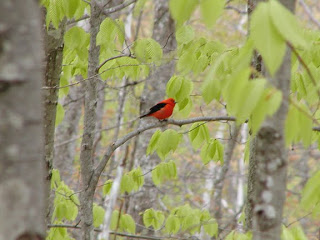
Scarlet Tanager at his summer home in Maine. Photo by Brian Willson.


Steaming hot coffee.
Tropical orioles flit
above ripened beans.

Note: The roasters I visited today, Green Tree Coffee, donate $1 to Coastal Mountains Land Trust for every pound they sell of one of four beautifully packaged Coastal Maine blends. You can buy their coffee via their website, or later this winter at their retail store opening on Route One in Lincolnville Beach.

January 12: Roadkill

Kristen Lindquist

Haiku are often Zen-like in that they capture the ephemerality of life, those moments that are here and then gone. The undercurrent of that train of thought is that we are all mortal, that our time on the planet is brief and should therefore be appreciated, even savored. I was reminded of this today as I swerved around a freshly-killed squirrel in the road. One minute that squirrel was a living creature, waving the fluffy plume of its tail, thinking about an oak tree across the road. The next, it was a grey body on the asphalt. To make matters worse, a little further down the road another animal lay dead on the center lines, a long, dark creature that may have been a mink. I think I've seen more minks dead than alive.

Road-killed animals always make me wince, and then I often say a short prayer for the soul of the animal. It seems only proper to pay this small respect to another living being whose life was cut short by something beyond its control and of which it had no real comprehension. Our roads and cars are intrusions on the natural space of the planet, causing millions of these small deaths every day. And I'm not trying to sound self-righteous--I drive around just as much as the next person--but to simply state a fact. A fact that not only makes the lives of these animals more precious, but also our own lives. We share this mortality. And it could happen just like that. So when I pass roadkill, besides giving a little thought to the creature lying there, dying there, in such an undignified way, I also can't help thinking about myself, taking a moment to inwardly rejoice that I am alive. And hopefully, the dead animal will become food for another animal, a scavenging crow or an opportunistic fox, thereby perpetuating the chain of life.

Road-killed squirrel, may
you end up in the black urn
of a crow's sleek throat.

Poetic note: I'm not happy with this haiku stylistically, because the lines are enjambed, and there is no kigo, or seasonal marker. But the sentiment is exactly what I wanted to express. Sometimes we have to sacrifice form for function--or in this case, take some poetic license.

January 11: A Bird in the Hand

Kristen Lindquist

My husband Paul recently sent an email to his co-workers delighting in the fact that he was hearing a chickadee singing its two-note "fee-bee" courting song. He saw it as an early sign of spring, something to give us hope as we shiver through the next few months. (I personally think it was just a typically over-eager male.)

While I haven't heard any chickadee love songs at my work feeder, I was pleasantly surprised this morning to observe a flurry of feeding activity there. The little guys can be quite fickle about their feeding stations. They can also be picky about their seeds, sometimes picking up and discarding several in succession until they find just the right one to carry away.

One of Paul's co-workers shared a story with him today about how after reading the chickadee email, he was encouraged to go out and buy a 50-pound bag of black sunflower seed. This past weekend before he filled the feeders, he sat on his deck with an open handful of seed. Here's how he describes what happened: "For five minutes nothing happened. Then three chickadees came investigating, doing reconnaissance swoops through the nearby trees... After ten long minutes, one jumped on my finger, glared at me angrily, grabbed a seed and took off... I was amazed and pleased. Never had that happen before. Felt like St. Francis." Saint Francis is, of course, the patron saint of birds, often depicted with outstretched arms bedecked with his feathered friends. According to legend, his "sister birds" would flock to him while he preached of the god who gave them the gift of feathers and flight.

My husband was of course thrilled that his email had indirectly contributed to such a memorable experience. There's something special about having a wild creature perch on you, as if you've been chosen somehow: the blur of wingbeat, something very light but very alive clinging to your finger with tiny feet for just an instant, then a cheeky glance from a beady black eye before the bird grabs a seed and flits away...


From your patient palm,
it takes the seed offering--
a form of blessing.


January 10: Breakwater Walk

Kristen Lindquist

Two of my New Year's resolutions were to spend more time outdoors and to step up my exercise regime. I believe that when you put a resolution out there, you are given the means to fulfill it. So when my friend Brian called this morning to ask if I wanted to walk the Rockland Breakwater, I remembered those resolutions and had to agree, despite temperatures in the teens.

It's about a one-mile walk from the parking lot to the lighthouse at the end of the long jetty. As you walk out atop its giant granite blocks, which are fit together like pieces of a massive 3-D puzzle, you're basically walking on a stone bridge that ends in the middle of the outer harbor. Sea ducks, loons, gulls, and guillemots bob in the waves on either side of you. Depending on the weather and tides, waves sometimes crash against the seaward side of the wall to spray across the rocks (and you), or an unusually high tide may have creeped over the farthest end, leaving the lighthouse rising above the waves as if it were a little island unto itself. The ferries to Vinalhaven and North Haven go to and fro. In the summer, lobster boats check their traps within shouting distance, and sailboats breeze past. You're conscious of being exposed to the elements--people have died from being struck by lightning out there. And no matter what the season, there's always a penetrating wind that seems to carry the force of the entire Atlantic Ocean behind it.

This morning's walk out wasn't too bad. We were both dressed warmly enough and the wind was at our backs. Most of the rocky surface remained relatively ice-free, enabling us to pick our way with relative ease. Long-tailed ducks gobbled nearby, and a little guillemot in its winter white plumage posed for a photograph. We even hung out for awhile in the lee of the lighthouse, trying to absorb some sunlight and warmth before the walk back in the teeth of the wind.

The wind's teeth this morning were those of a shark. My body was warm enough, but because part of my face was exposed, every sinus in my head ached. My contacts blurred in the frigid blasts of the northwest wind. I would like to have better admired the beauty of the snow-covered Camden Hills in the distance behind the Samoset Resort, but I couldn't really see. At one point, a loon surfaced quite close but disappeared before I could point it out to photographer Brian. I kept mistaking buoys for ducks. But there's nothing for it but to keep on walking, and eventually we stepped down off the wall onto the beach. I think both of us were a little pleased with ourselves for enduring, though really, what choice did we have? And this was for fun, after all.

We walk on ocean,
on urchins, on ice-sprayed stones--
cold realm of the gulls.

January 9: Winter Birding Excursion

Kristen Lindquist

I finally got a chance today to spread my wings a bit and indulge in a bird outing in southern Maine with my friend Brian. Our target species: the harlequin duck, a bird which would be a lifer for Brian. In my opinion, it's also the most beautiful of the many kinds of duck we can see in Maine--the males are mostly slate blue with a touch of rose, featuring intricate white facial and body markings. They love surf, and spend winters hanging out in small pods on the edge of crashing waves along the southern Maine coast, often quite close to shore. One of the best ways to see them well is to take a chilly walk along the Marginal Way in Ogunquit, but I hoped to find them a little bit closer to home on this jaunt.

But first, a short side trip. We purposefully drove south via Route One through Warren to check out a poultry farm that attracts a fair number of our wintering eagle population. Literally dozens of bald eagles are regularly counted along the St. George River each winter. Many of them hang out at a big poultry farm on Route One to scavenge the farm waste there. Today was no exception. We counted maybe 33 bald eagles in the immediate vicinity of the farm. It looked like those photos you see of the Chilkat Bald Eagle Reserve in Alaska, with an eagle posed on every branch. The eagles were also joined by several ravens and crows, as well as one red-tailed hawk. A dramatic start to our morning, especially as some of the eagles were vocalizing. You never get used to seeing that many eagles all in one place.

First stop for the harlequins was Dyer Point in Cape Elizabeth, an outcropping of striated metaphoric rock that looks a bit like petrified wood decorated with colorful tide pools. We scanned flocks of common eiders looking for a king eider that's been hanging out there--someone saw it yesterday, in fact--but no dice. After much scanning while enduring a bone-chilling wind, however, I did manage to find one male harlequin bobbing offshore. We risked life and limb walking on frost-slimed rocks to get a closer look--and Brian got his life bird! At the next stop, Two Lights State Park, we were even more fortunate to find a group of eight harlequins--four males, four females--also close to shore. The ducks entertained us by repeatedly ducking underwater simultaneously, as if on cue. The males engaged in a little posturing, as well, chasing each other and otherwise showing off while the females looked on, probably thinking what females usually do when they witness such antics. (Brian got some distant photos of these birds and others we saw today, which he will post on his Bird Report blog.)


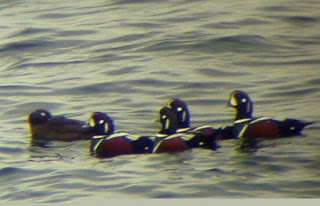
Harlequin ducks photographed in 2003 along the Marginal Way

So, mission accomplished without even having to drive all the way to Ogunquit--a satisfying day in terms of birds, and in the company of a good friend. We even got an added nature-watching bonus when a big, healthy-looking doe crossed the road in front of us near Crescent Beach State Park in Scarborough. Though it's difficult to say exactly who was really observing whom, for she stood in the woods watching us for quite a while as we watched and photographed her from the roadside.

Some things are best shared:
winter ducks bobbing in surf,
eagles perched in pines.